
You are currently browsing the category archive for the ‘Reviews’ category.

Lindsay Teed and Anna Marie Sell as Viola and Olivia
“Be not afraid of greatness” is the advice Malvolio gets from an anonymous letter in William Shakespeare’s Twelfth Night. “Some are born great, some achieve greatness, and some have greatness thrust upon ’em.” Our officious, comedic villain hopes the greatness of his mistress Olivia will be thrust upon him, a thought that tickles him in all the wrong places. Ever ready to put a subordinate in his place or flatter his betters, when he sees the opportunity to move up the social ladder a rung or two Malvolio exults in the thought that he could be better than he is.
The idea that you can be better than you are was laughable to the play’s Elizabethan audience. You were born into your place; you stay in your place; and morality consists of being faithful to who you are. People act immorally when they put on airs, or act beneath their station. We laugh at the type of fool Malvolio represents in hopes that public scorn will teach him a lesson in humility. It’s an important lesson to learn, because those who don’t learn it turn into tyrants and / or corpses.
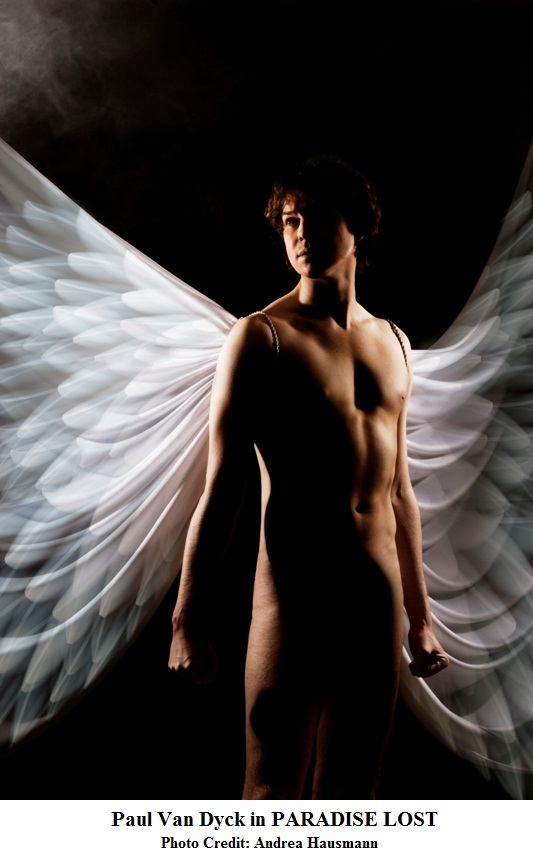
When asked who is the greatest poet in the English language, most people will say “Shakespeare.” When asked who is the second greatest poet they might say “Keats.” But would anyone say “Milton?” These days it’s hard to find a college graduate who has read Animal Farm from cover to cover, much less Paradise Lost, written by a man who was once thought to be a greater poet than Shax himself.
But it was not always thus. John Dryden, himself a onetime contender for the title of greatest poet in the English language, friend and younger colleague to Milton, supposedly said after reading Paradise Lost, “This man cuts us all out, and the ancients too.” Though Milton was an old republican revolutionary and Dryden a loyal monarchist, Dryden liked Milton’s epic so much he adapted it for the stage by rewriting it in rhymed couplets and setting it to music.
Paul Van Dyck has done Dryden one better by keeping Milton’s sublime poetry unrhymed and using all the modern theatrical arts to make Paradise Lost come to life at the FRIGID Festival. I can say without qualification that this is the best theater – the most relevant to our time, the most uplifting, the most artistic, simultaneously the most esoteric and exoteric, visually, aurally, and intellectually stimulating – that I have seen in a long time. And running under an hour, it makes getting some high culture as enjoyable as possible for those of us inflicted with ADD by the modern age.

Lori E. Parquet as Rozetta Stone
“I will speak and end all suspense” ~ Zetta Stone.
Liz Duffy Adams’s play Dog Act is one of those, what do you call them? Where a thing is its definition? Like the word “pentasyllabic.” Anyway, it’s that, a Dog Act: the last shred of dignity the modern world can leave to the later-than-modern world, the no-longer-modern world, the future world. Whatever happens when pastiche becomes fact, that is Dog Act. We are such stuff as dreams are made on, and no dream is more satisfying than “the present.”

The title of Thomas Bernhard’s play “Ritter, Dene, Voss” comes from the surnames of the three actors who premiered the roles in 1986: Ilse Ritter, Kirsten Dene and Gert Voss. It is worth noting as well that Ritter means “knight” and Voss is an aristocratic surname from the fourteenth cenutry. This is significant because “Ritter, Dene, Voss” is a play about the death of the Viennese ideal of urbane aristocracy and the horrible, beautiful flowers that bloomed in the rotting dung heap of post-World War I Austria.

On a darkened highway in upstate New York a cute, fuzzy bunny is transfixed by the glare of headlights and the roar of an internal combustion engine. The poor rabbit’s eyes widen in horror, and his lip quivers uncontrollably as the car swerves. The innocent lapine wanderer is struck hard by two tons of steel and rubber, but it’s only a glancing blow; and though his back legs are crushed, his heart, still hammering with fear, has survived. The car screeches to a halt, and a woman gets out. She’s pale and trembling like the rabbit. She picks him up gingerly, and tells him it’s going to be alright. She wraps him in a towel, puts him in her car, and speeds off, into the night.

Paul Herbig and Richard Altmanshofer in "Donnie and the Monsters"
Kids live in a world full of problems. Who can help? Mom and dad have their own problems. Heck, sometimes they are the problem. Best friends are fickle, especially in those crucial years between the halcyon innocence of deep childhood and the flowering of full adolescence. Tell your friend a shameful secret in confidence, and when school starts again after summer break, your best friend has a new best friend, and the whole class is sniggering about you behind your back. You might as well tell your troubles to Mr. Chips, your fat, black lab, the soul of patience, or a sock puppet. At least Mr. Chips won’t talk back.

Let’s do the time warp again! And by “time warp” I mean warping to an alternate universe about six months from now when the Nouveau Burlesque, downtown New York’s indigenous revival of the Great 20th Century American Burlesque, opens on The Great White Way. Now, this is an alternate universe, so it looks similar, but it is not identical to our own. In this alternate universe, some greats of our contemporary scene have different names and different histories: Jo Boobs is still the boss, but the alternate Boobs is still partying like it’s 1979. The famous, gritty theater where it all goes down is either The Box or the Slipper Room crossed with the Minsky’s National Winter Garden Theater, circa 1925, and the beautiful ingénue isn’t a brainy, erudite Fordham grad, she’s an NYU doctoral student writing a thesis on alternative gender performance, circa 1995.

What dark horror lurks beyond this vale of wrath and tears? Is it the undiscovered country, from whose bourne no traveller returns? Is darkness the mere nothing at the end of the world, as Byron imagined in his poem “Darkness”? Is it where the monsters hide in your bedroom? Or is darkness that which we carry within us, the “palpable obscure” of Hell that Satan laments in Paradise Lost:
Which way I fly is Hell; myself am Hell;
And, in the lowest deep, a lower deep
Still threatening to devour me opens wide,
To which the Hell I suffer seems a Heaven.

Blood sucker or theater critic?
The Theater of the Expendable is staging Conor McPherson’s 1997 play St. Nicholas at The WorkShop Theater in Hell’s Kitchen. Darrell James plays McPherson’s narrator for ninety captivating minutes.
St. Nicolas is a play about power and parasitism. The narrator is a middle-aged, Dublin theater critic who hits rock bottom, and after a long decline, runs away to London to become the R. M. Renfield for a group of vampires. The set is a single chair, and the play an hour and thirty minute monologue. The nameless narrator tells us, the audience, a ghost story starring himself.

The Rising Sun Performance Company is now performing Dan Rosen’s movie cum play The Last Supper at The Red Room. It’s a rip-roaring good time, and well worth your dime.
A conservative is a liberal who’s been mugged
The official blurb runs something like this: A group of young, liberal graduate students in Iowa have a formal, sit down dinner once a week, to which they like to invite a stranger – to spice up conversation. Their ivory tower serenity is disturbed, however, when their latest guest, Zach (played in the 1995 movie by Bill Paxton!), turns out to be a redneck, pedophilic, murderous, Holocaust denier. Zach taunts the tolerant liberals, saying that they don’t have the balls to stand up for themselves, and pulls a knife on Marc, the resident Jewish artist. Zach is distracted for a moment while breaking the arm of Peter, another sissy liberal, and Marc seizes the opportunity to stab Zach in the back with his own knife. Existential angst ensues as the “liberals” try to justify their aggression. They rationalize it so well that they decide to recreate the scenario every week with a new flavor of conservative crazy. Their preferred method of execution? Poison in the chardonnay.
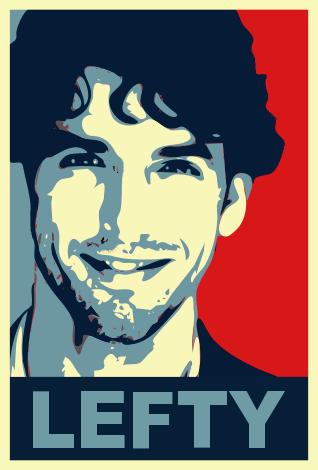
Waiting for Lefty at ATA's Sargent Theater
You may not guess it from the picture of the handsome man above, but Lefty is a leftist, a commie, a red — and not in the Texas “Red Meat” way. You might think of this guy as a Lefty for The Great Recession — cool, hip, possibly living in a palatial squat in Buffalo, refusing to use currency or pay for food.
And yet, it was not always thus.
The enduring strength of Clifford Odets’s play Waiting for Lefty is its focus on character rather than identity. That may seem like a subtle distinction, but it’s an important one that traces the success and failure of the labor movement in the USA from Odets’s time to ours. Odets’s characters are honest, working people who strive for a measure of human dignity and are systematically deprived of it by the Bosses, the Owners, and the unsympathetic, pampered, and callous Elites. Odets builds his characters through their struggles: they are dynamic, not static. But in the intervening three quarters of a century since this play was first produced “identity” as a pillar of capitalist ideology has dominated and marginalized character so thoroughly that the didactic purpose of this play, what Brecht would have called a lehrstück, is easy to miss. Waiting for Lefty is the greatest work of American agitprop theater because it attempts to dramatize how a person learns courage in an act of character building, rather than appealing to the audience’s fear and pity.
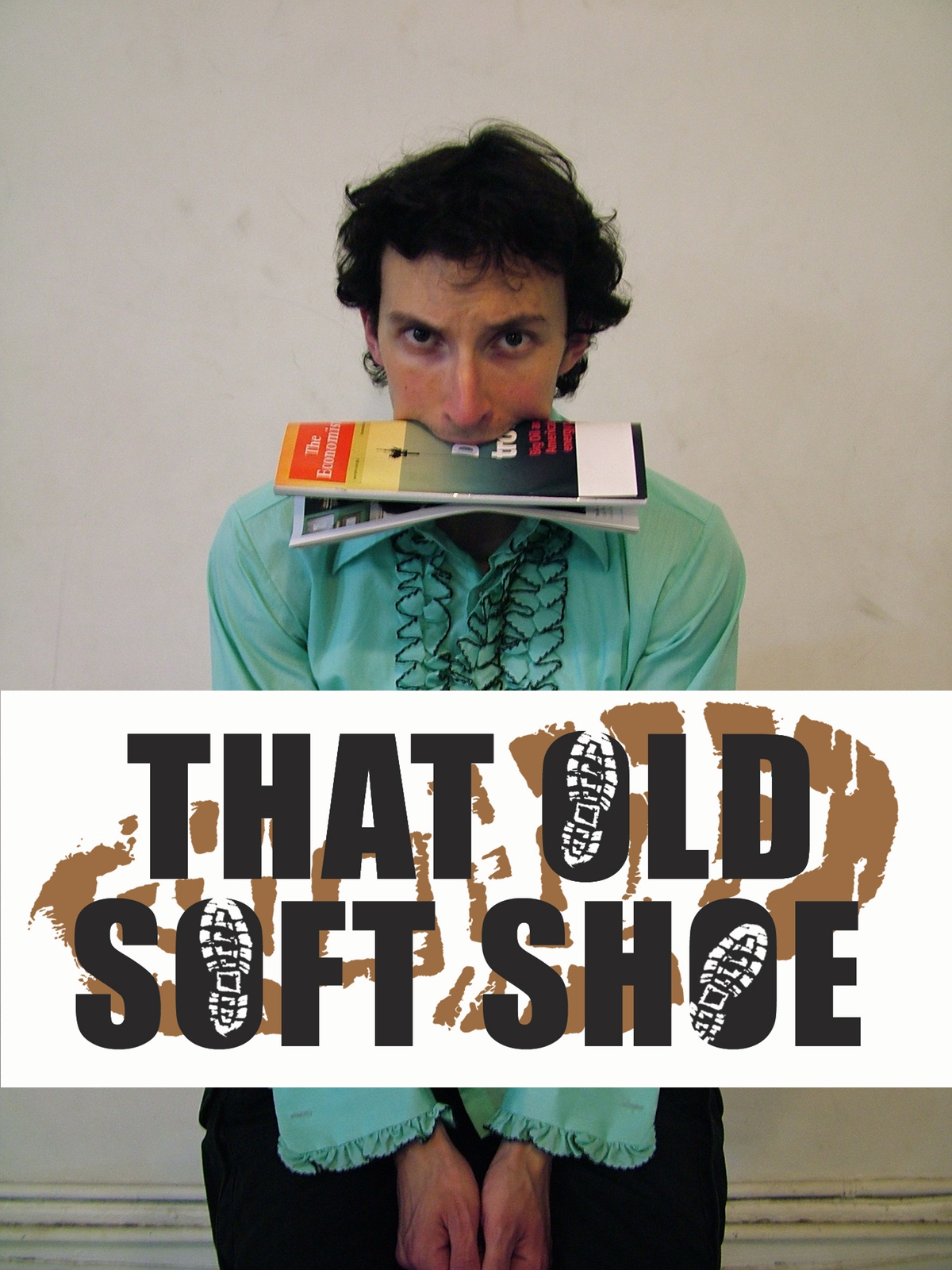
The Patient from "That Old Soft Shoe" at The Brick
How many comedies about torture there are in the naked city! Maybe not all of them are comedies, but it seems like our Empire City response to 24 and the Bush years has been laughter – hysterical, terrified laughter, of the mad scientist variety.
Kyle Ancowitz’s production of Matthew Freeman’s play That Old Soft Shoe at the Brick Theater in Williamsburg is a hilariously irreverent, frenetic, and absurd send up of 24 and its genre of fear mongering drama that will keep you laughing all the way to a highly classified black site in Jordan – or more probably, Florida.

Amir John and Lakshmi fight in "Before Your Very Eyes"
“Who are you going to believe? Me or you eyes?” —Groucho Marx
I jokingly asked myself on the way to see Before Your Very Eyes, a play about 9/11 at the Flamboyan Theatre, “Is it too soon? Is nine years long enough to get a grip on the real truth of 9/11?”
I thought I was being facetious, but the question goes to the heart of what Edward Elefterion, the writer/director of Before Your Very Eyes is aiming to do with his play. The question “what happened” is a question of perspective. Each one of us who were in the city on 9/11/2001 have a personal story about that day that we have shaped and polished over the years into an appropriate three minute downer that you tell people outside the City. “I did (or didn’t) see a building fall with my naked eyes”; “I knew (or didn’t) someone who worked there.” A lot of us have stories of friends who were supposed to be near the World Trade Center towers that day and for some reason weren’t; many of us saw figures covered in concrete dust streaming across the East River bridges into Brooklyn; some of us trapped outside the city had to watch our city cope with disaster from a distance.
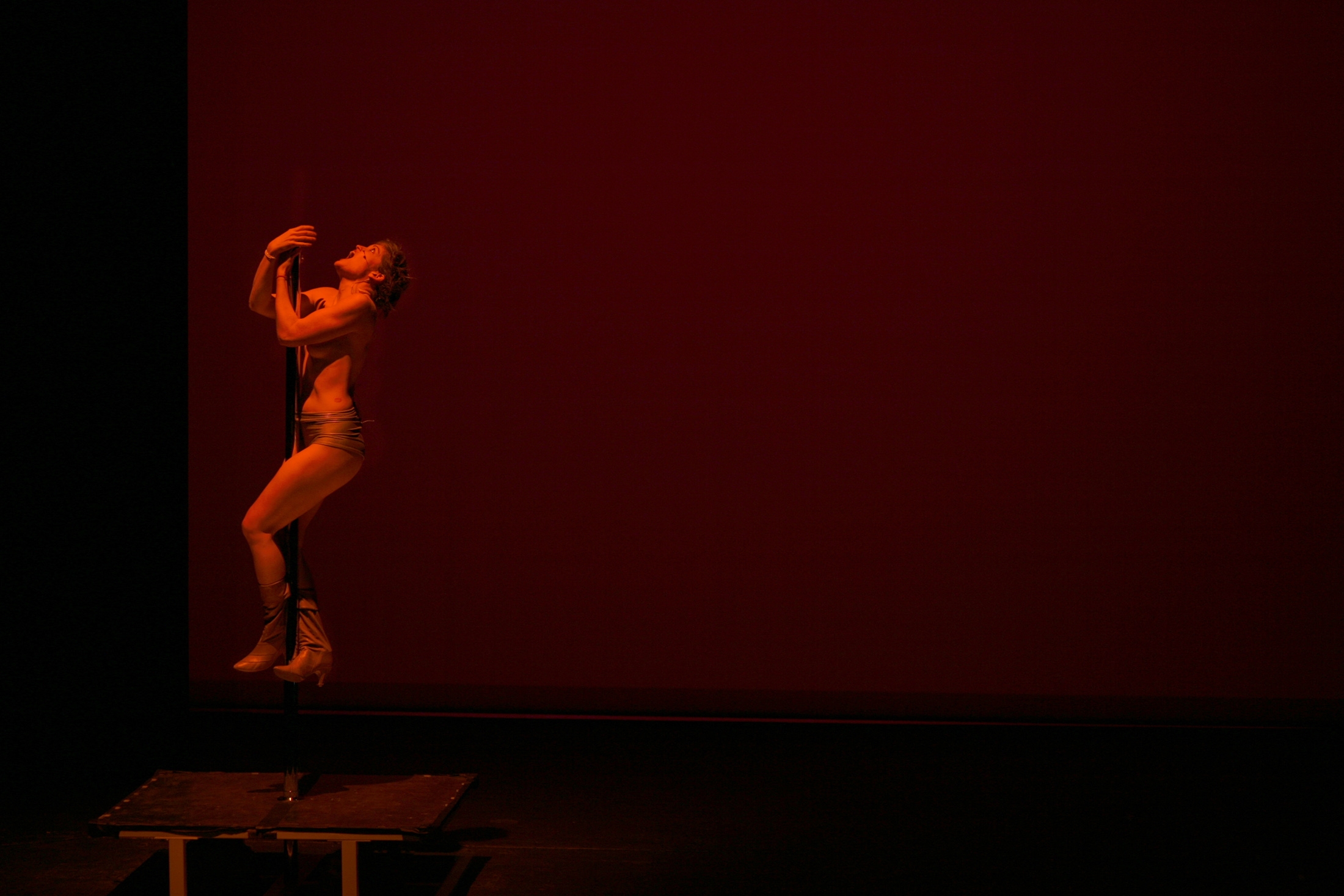
Erin Markey in "Puppy Love: A Stripper's Tail"
Some girls give me money,
Some girls buy me clothes…
Erin Markey’s one woman show Puppy Love: A Stripper’s Tail is a must-see tale/tail for all you ladies and gents (but mostly ladies) who work in the gray area between theater and erotic arts in New York. It’s also worth seeing if you don’t work in that lovely, glistening niche of the alternative entertainment world. But if you are a woman who has ever wondered how glitter got into that, or categorize men as “sweet hearts” and “pervs,” or looked in the mirror and said “I’d do me,” this is a show you can’t miss.
Guys on the other side of the tip rail will appreciate this play too. Strippers, erotic performers, and sex workers have earned their own technical name in the world of knuckle dragging, ham-knecked, mouth breathers: “stripper crazy.” Stripper Crazy is the kind of girl who, after three cocktails, leans over and whispers in your ear that she thinks you’re a sweet heart, and do you want to go to the bathroom for some X-rated fun? Then, three cocktails later, when you’re at the bar buying her another drink, you hear her siren giggle as one of the pervs from the table next to yours, the table of guys who earned her scorn when they leered and cat called, hoists her over his shoulder and takes her to the bathroom for a little X-rated fun.

Playbill graphic for "Jacob's House"
The earth also was corrupt before God, and the earth was filled with violence. And God looked upon the earth, and, behold, it was corrupt; for all flesh had corrupted his way upon the earth. And God said unto Noah, The end of all flesh is come before me; for the earth is filled with violence through them; and, behold, I will destroy them with the earth…. And, behold, I, even I, do bring a flood of waters upon the earth, to destroy all flesh, wherein is the breath of life. — Genesis 6: 11-13, 17
A Klee drawing named “Angelus Novus” shows an angel looking as though he is about to move away from something he is fixedly contemplating. His eyes are staring, his mouth is open, his wings are spread. This is how one pictures the angel of history. His face is turned toward the past. Where we perceive a chain of events, he sees one single catastrophe that keeps piling ruin upon ruin and hurls it in front of his feet. The angel would like to stay, awaken the dead, and make whole what has been smashed. But a storm is blowing from Paradise; it has got caught in his wings with such violence that the angel can no longer close them. The storm irresistibly propels him into the future to which his back is turned, while the pile of debris before him grows skyward. This storm is what we call progress. — Walter Benjamin
Hey kids, 2012 is just around the corner, and after a dry, post-Y2K decade, Biblical metaphors are back in style, flooding the stage (as it were) at the same time the Tennessee Valley is being flooded by a real, not metaphorical flood. Two productions up now, Noah’s Arkansas and Jacob’s House use these metaphors to explore the Great American Love Affair with Apocalypse.
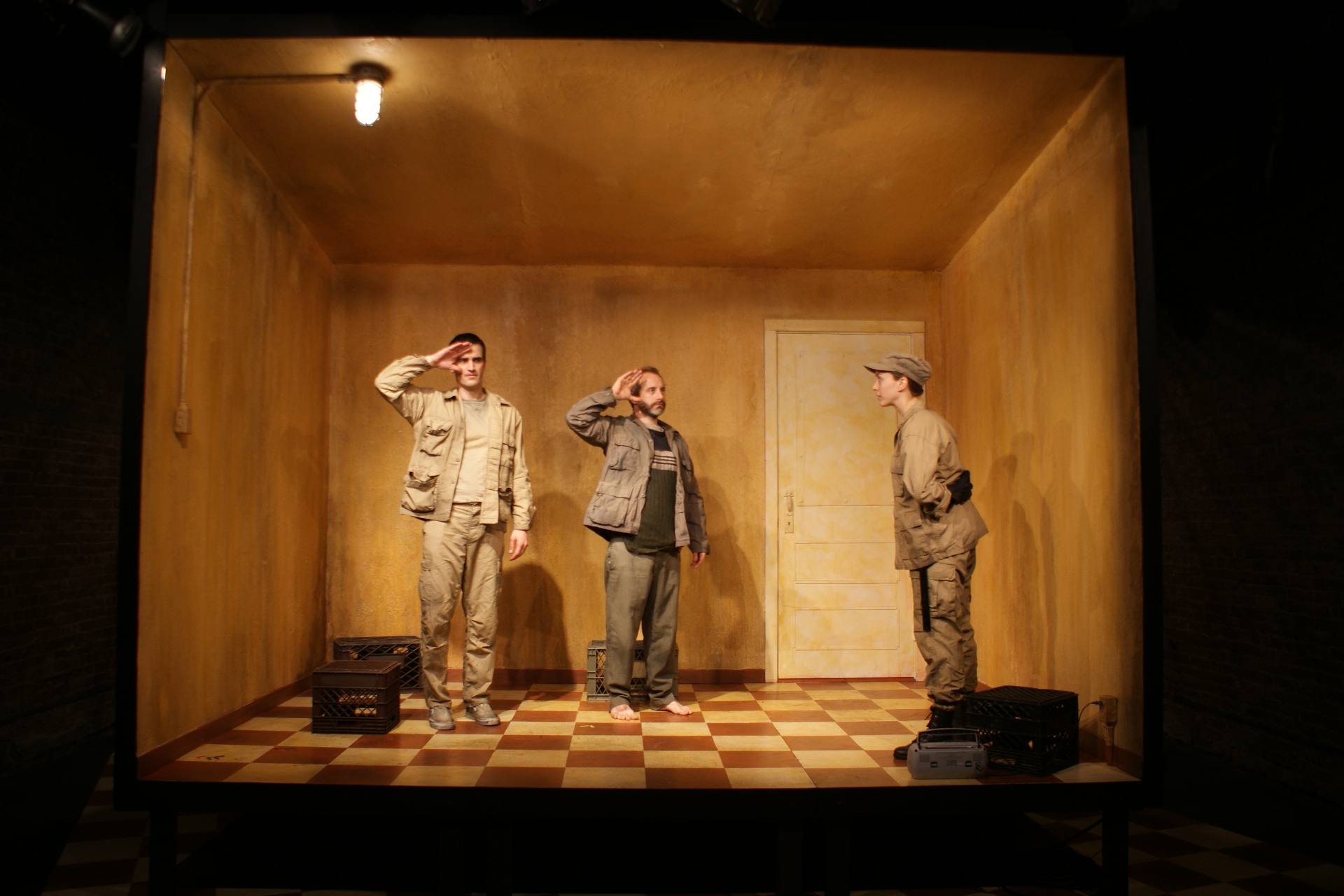
Zig and Alex salute Rose in "The Tender Mercies"
Live theater aims for two things: truth and intensity. Oftentimes they are in a zero-sum relationship to one another. That is, the more you have of one, the less you can have of the other. On one hand, truth commonly understood is elusive, messy, and boring. Reading a thousand cotton-mouthed books might get you close to understanding why your pension is still in peril. Intensity, on the other hand, is crack cocaine or sugar coated choco-bombs: full of immediate high, it can’t be weighed down by buzz killing substances like facts. Take, for example, any speech by Sarah Palin. Occasionally, however, a play can convey a great truth and be intense at the same time. That is most definitely the case with The Tender Mercies playing this week at the Teatro Círculo on East 4th Street.
Read the rest of this entry »
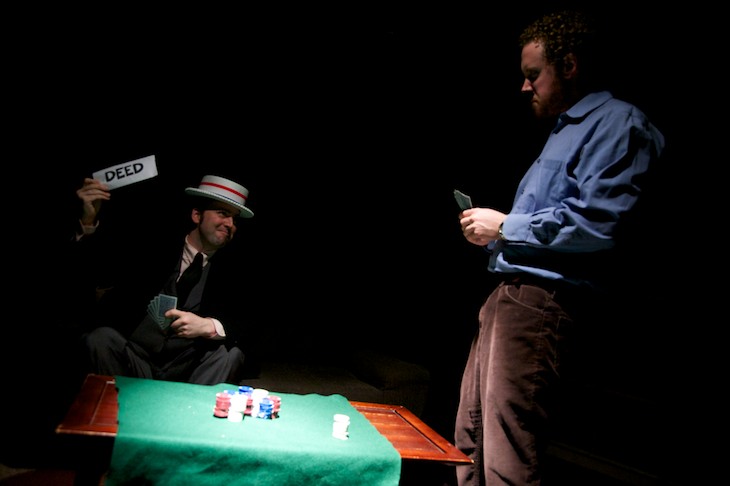
Jeff Sproul and James Patrick Cronin in "Poppycock"
Just what did you expect for nothing? Rubber biscuit?
A guy walks into a bar and says “ouch!” No wait. I told that wrong. A man and a woman walk into a derelict bed and breakfast carrying the woman’s catatonic sister. This is the last night the bed and breakfast will be in business because an unscrupulous Richie Rich, a real Snidely Whiplash, is about to repossess it from its humble bumbling owner. And then they say “ouch.”
Poppycock: A Modern-Day Farce at Under St. Mark’s Theater from now until April 24th is roughly an hour and a half of non-stop gags, jokes, tom-foolery, one-liners, puns, witty repartee, and monkeyshines. It’s like Monkey Business meets Fawlty Towers envisioned as a live-action Tex Avery cartoon (like Malcolm in the Middle). I laughed through the whole thing.

What does a world without hope look like? Is it a bleak moonscape — black sky, cold sun, gray hills? Or is it the too perfect world of American suburbia, where the sun — and the smiles — shine a little too bright; where too-green, cultivated lawns lead to soothing interiors, painted in shades named “Ocean Side”, “Interactive Cream”, and “Moderate White”; where real freedom is banished to the gritty, marginal, blind spots of ubiquitous surveillance cameras?
The Realm, running from now until April 18th at The Wild Project in the East Village, is a futuristic dystopia in the tradition of American post-apocalyptic dystopias like Logan’s Run, A Boy and His Dog (remember that one? Don Johnson starred in the movie!), and, closer to our time, Urinetown. The time is the not-too-distant future. After an unnamed cataclysm, humanity has been forced underground. Natural resources are scarce — especially water. Human beings have learned how to live spare, lean lives, stripped of all superfluity — and fun. And, for that matter, freedom. Water is rationed, life is rationed, even words are rationed.
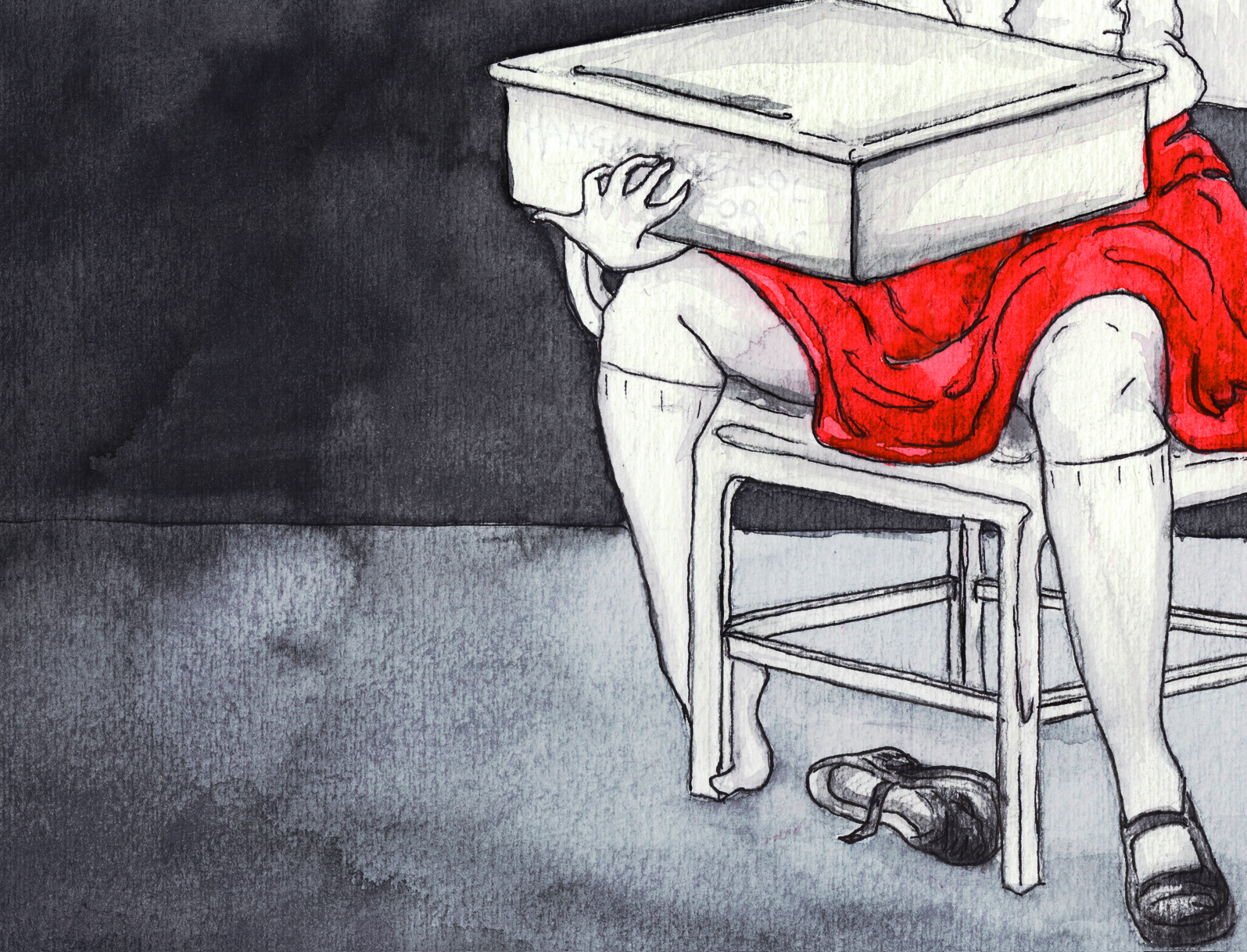
The lights come up, and a group of girls parades into a classroom. Three march in military cadences around their acknowledged queen standing on a desk: Chelsea, whose name evokes the precincts of money and class in both New York and London. They carp in posh English accents, the kind that set my teeth on edge when they aren’t done well. (American actors usually slip into something that sounds like a poor man’s Monty Python.) But the actors keep it together admirably as Chelsea self-consciously plays the Queen of Hearts from Alice in Wonderland to her sycophantic entourage. Then a fifth actor comes on stage, taller than the rest, with a lean and hungry look, but also painfully shy. Alice in Wonderland meets Mean Girls. Queen Chelsea and her court give the new girl the standard test for rank in their disciplined hierarchy: Name?! Hazel. (Rather boring and dowdy – points off.) Family vacation spot?! France. (Also boring, but better than Brighton.) It looks bad for Hazel when she tells the court – without being prompted! – that her family went to France on a cheese tour. Definitely not cool. The hierarchy is settled and the ladies take their desks in order of rank. Hazel, being the lowest, has to take the creepy, ancient, wooden desk in the corner.
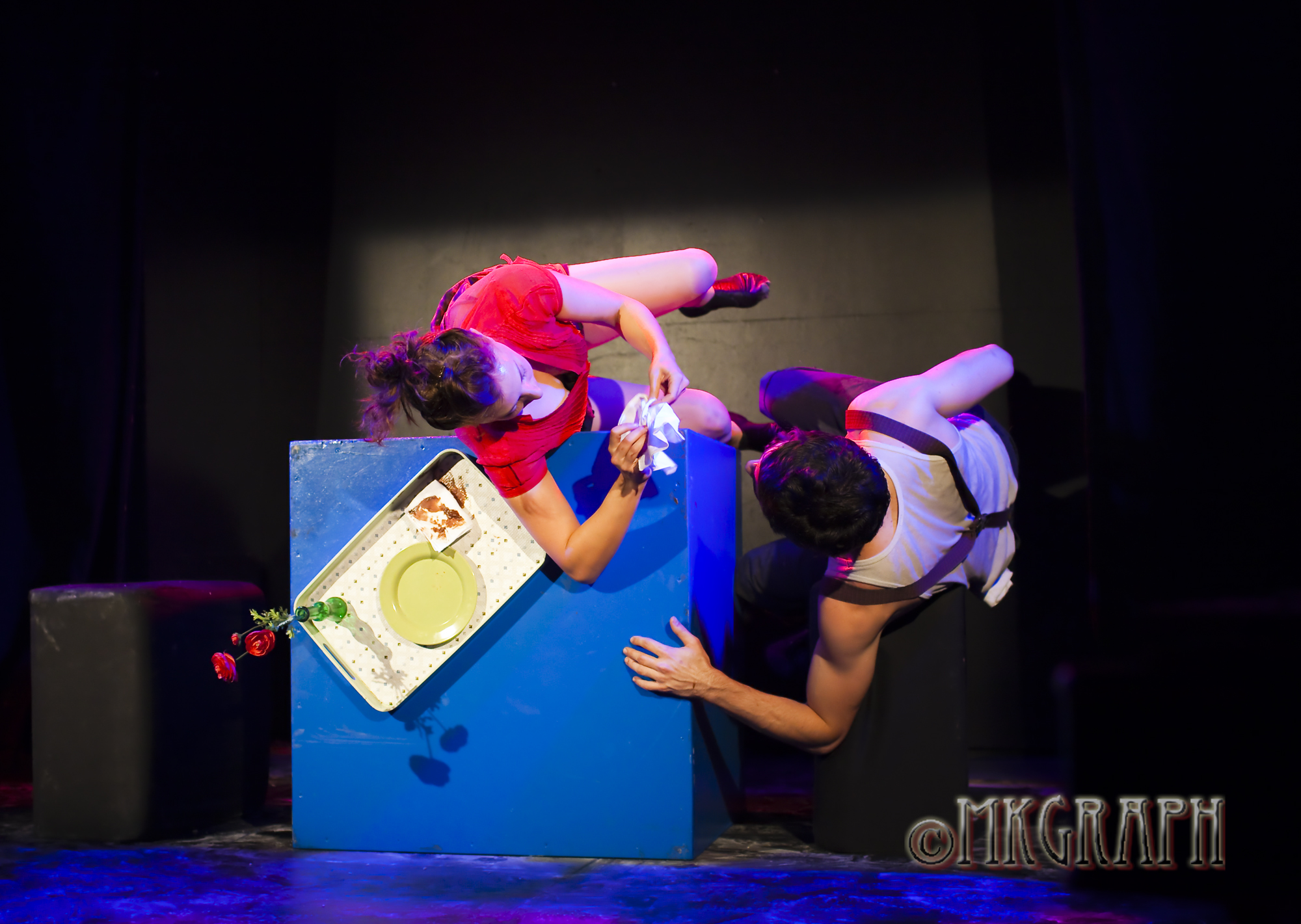
Have you ever wondered what would happen if gravity changed its direction? Like, what if left was all of a sudden down? How would the stuff in the room that’s not nailed to the floor readjust itself ever so violently into the wall? The thought is a pleasantly anxiety producing mental exercise – what would I do if the room I am in was suddenly tipped on its side? It’s good to get some perspective on life, even if does require being head over heels. Isn’t that why people go to the theater or see movies anyway?
Romantic love, the kind all the movies are about, often produces the same vertiginous feeling, as if the room you are in is about to be suddenly and without warning tipped on its side, and you and the charming person you are with might be literally thrown together in to all kinds of awkward, unexpected physical intimacies. Poets have used anthologies full of metaphors to explain this effect: love is magic, transforming a skinny, awkward duckling into a graceful swan; love is a hallucinogenic drug that can give you angelic (or demonic) visions; ultimately, love is the feeling of flying, and the attendant fear, complete with sweaty palms, a queasy stomach, and the desire to squeeze your eyes tightly shut, so you can’t see what a predicament you’re in.

Ars Gratia Artis
Are you the kind of person who got a bonus from Santa Blankfein, and wants to blow it on a family trip to see a revival of “West Side Story” from seventh row center? Do you like your theater to observe the Aristotelian unities of time, place, and action? Do like it when a play is “realistic” or “believable”? I bet you watch a lot of reality TV too. Yeah, that’s right. You heard me. Simple plots, syrupy sentiments, lots of slow-mo’s and major key power chords, that’s what you like, you philistine.
Now, if you prefer the nitty-gritty, avant-garde; if Zach Galifianakis and John Hodgman leave you in stiches; if you live for the excitement of theater so live you can feel the blood, sweat, and tears of the performers sprinkling your hair and getting caught in your mustache, the FRIGID festival, on till March 7th is for you. Give thanks for New York City, where you can see theater that is truly “state of the art.”
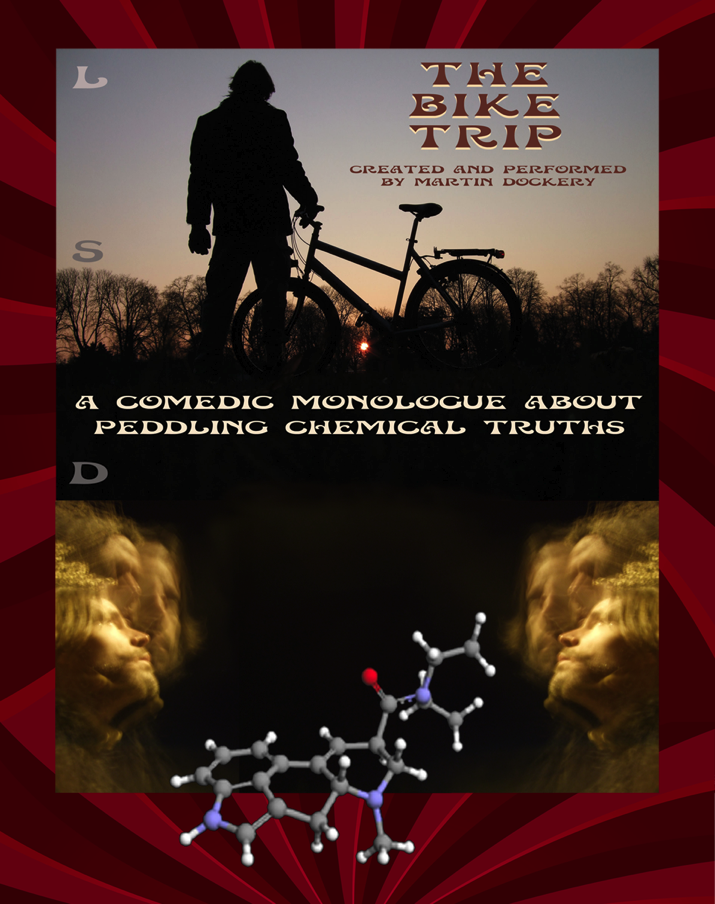
In college, a friend of mine said tripping on acid was the ultimate inside joke: if you’d done it you got it; if you hadn’t you wondered what the big deal was.
You could say the same for modern art, religious enthusiasm, and fashion week. From an outsider’s perspective the shiny, happy faces and breathless testimonials are either delusional or cynically fake. But LSD is more than a social convention or manifestation of groupthink; it affects the body and the mind – the bodymind – simultaneously, fusing the two in the most unexpected and necessary ways. In religious terms, it’s the equivalent of Eve eating the apple. Before you taste it you are an extra in the movie of your own life, observing your emotional pain with cool detachment through the lens of endlessly repeated, self-deluding narratives. From the secure perch of innocence nothing can really touch you. Afterwards you know the meaning of good and evil from the inside.
Martin Dockery’s new dramatic monologue The Bike Trip playing now at the Kraine Theater explores the awakening promised by LSD and its ramifications thoughtfully and with nuance. And he gives the audience a rather large dose of humor too.
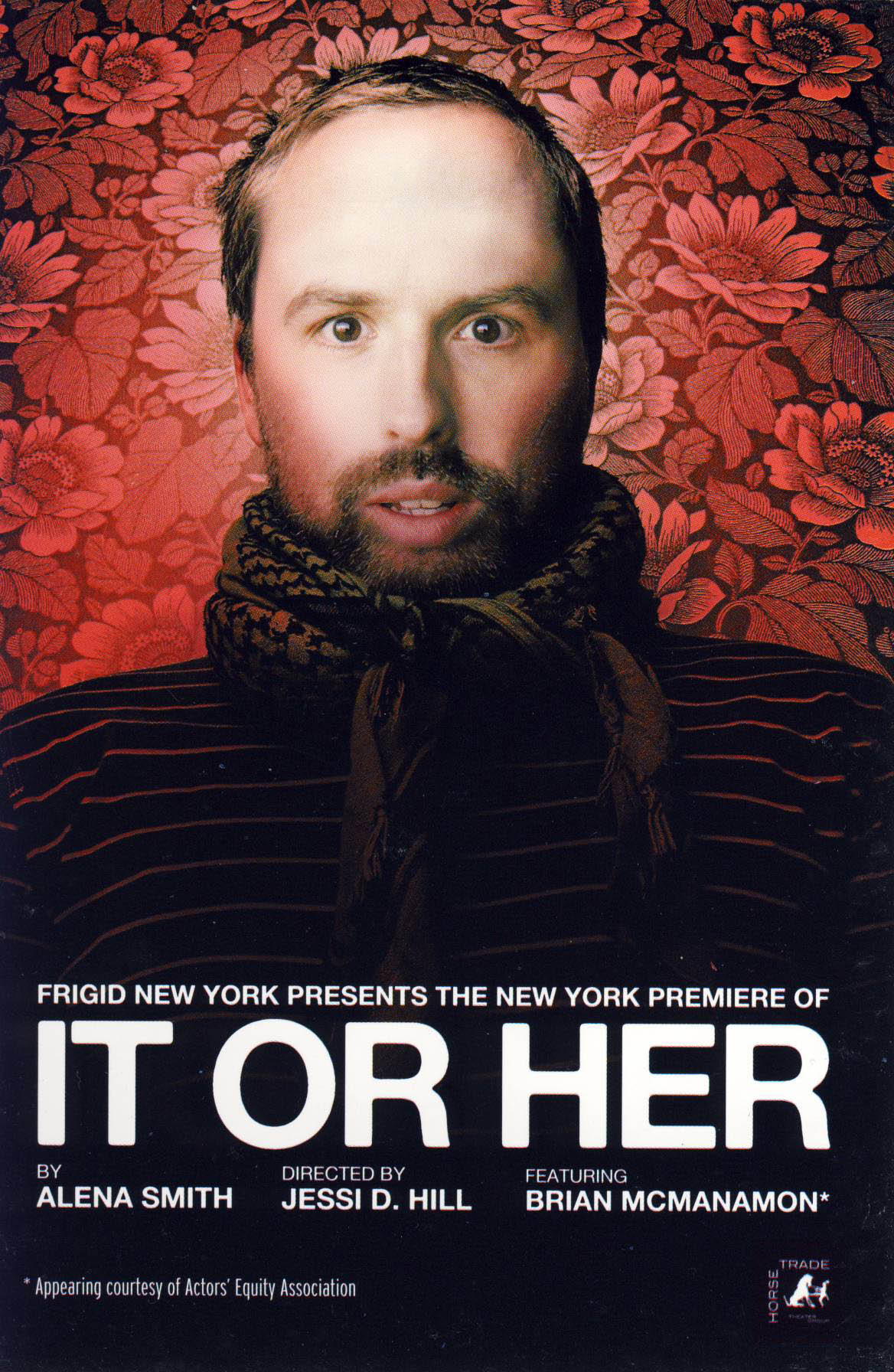
IT OR HER, a new play by Alena Smith being performed now at the FRIGID festival is a cross between Poe’s “The Tell-Tale Heart” and Baron-Cohen’s “Brüno”. When that pitch line occurred to me in the darkened theater, I thought I was being pretty clever (if catty), but when I read the official blurb in the press packet I saw that the allusion was intentional. The playwright intentionally copped Poe’s “The Tell-Tale Heart”, albeit in a cute, neo-absurdist way.

Kelley Girod
The question posed by the artists collected in the series of short plays entitled “The Fire This Time” currently playing at the Red Room asks “is there post-black black theater? If so, what are the stories?” The answer is a diverse collection of seven short pieces that cover race, nationality, gender, and fantasy.
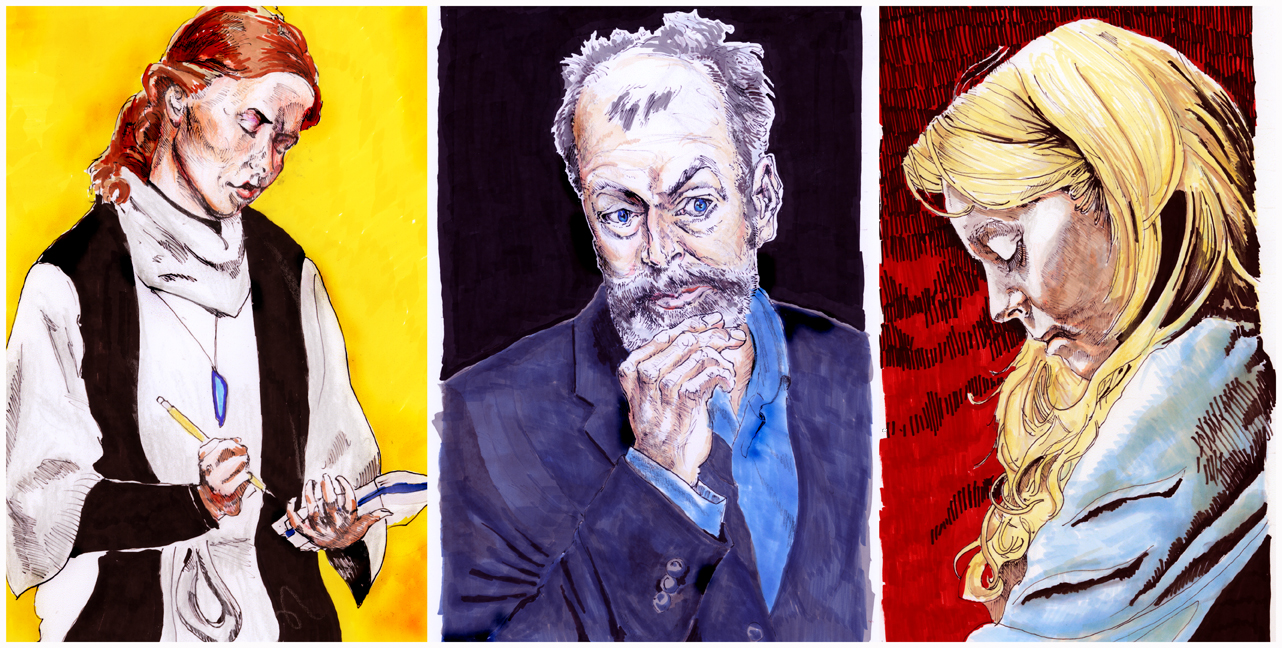
The cast of The Three Sisters by Anton Chekhov barely fits in the Red Room on West 4th St. There are fourteen actors (14), who represent over a third of the living creatures in the tiny space on top of KGB bar. The play is also crammed full of personalities: the sisters of the title, their brother, his wife, the alcoholic doctor, the Baron, his ill-mannered friend, the school teacher, two soldiers, the elderly female servant, the elderly male servant, and the artilery commander. It’s a lot of emotion to pack into a space the size of a one bedroom apartment.
Like a silvery, slippery sardine is kind of how you feel when you sit down, elbow to elbow with other viewers, and with your knees poking into the actors. (The seats are set in the round, so to speak, on the perimeter of the play space that stretches the length of the floor.) This is not in-your-face, interactive theater like De La Guarda, where the performers dance with the audience during the performance, but I get the feeling that the large company, the director Jess Chayes, and the set designer Nicolas Benacerraf were making a virtue of necessity when they wrapped the audience around the players in an almost uncomfortable embrace.
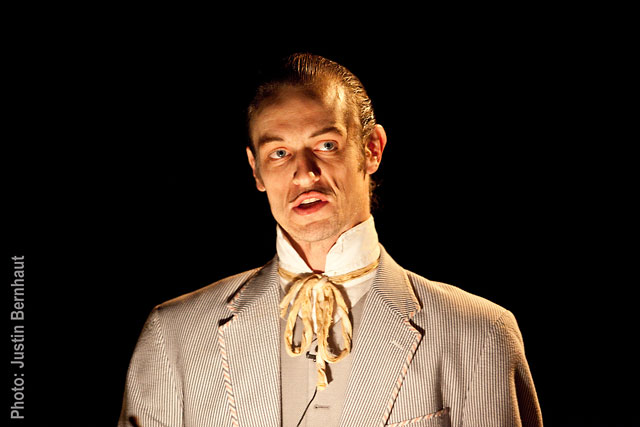
Richard "Dick" Pricey (a.k.a. James P. Stanley)
How many times over the last ten years have you been embroiled in a conversation about what to call the last decade? The “Ohs”? The “Aughts”? I think part of the outpouring of relief two weeks ago when we entered the identifiable “Tweens” was due to having a commonly accepted label to put on our present historical period. When have the first ten years of a decade had anything in it worth remembering? What happened in 1905? What was the big news of 1810? Retro was popular in the 90s, but these days — sheesh! — you can’t swing a dead cat in a circle without hitting somebody who’s living like it’s 1899.
Is this a sign of national decadence and decline? The impulse to get back to a more wholesome time is surely behind the National Theater of the United States of America’s production of “Chautauqua!” at the Public theater.

Tanya O'Debra in Radio Star
Everything old is new again! At least that’s how it feels these days. Five long years ago the vogue in vintage was vintage 70s — 1870s that is. Remember when conservatives wanted to repeal income tax and Social Security? It was the new Gilded Age.
But ah, how quickly the worm turns! Now vintage styles in dress and drink reflect the more sober times of the Great Depression and the privation of WWII. Only we call it the Great Recession, and our great global war is being fought by guys with explosive powder in their banana hammocks.
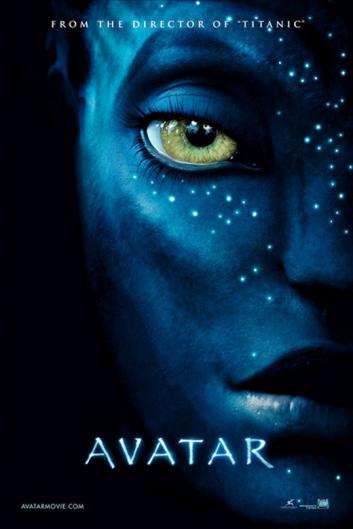
So far James Cameron’s Avatar has gotten predictably mixed reviews. On one hand, the visuals and heroic story are grounds for A. O. Scott of the New York Times to rave “I had the feeling coming out of this movie that I haven’t felt since maybe I was eleven years old in 1977 and I saw Star Wars for the first time.” It has also been panned by critics like Kevin McCarthy for having a “derivative, unimaginative story and … shallow characters.” Says McCarthy, Avatar matches “terrific special effects with a lousy script — which is the way Hollywood has made many movies in the 32 years since Star Wars.”

Cate Blanchett as Blanche Dubois
It seemed appropriate to be waiting on two self-described Southern belles to get into Streetcar at BAM last week. Nothing says “Southern” like being late to your own party. We were four, and at least three of us hail from south of the Mason-Dixon line, or as another of my Southern friends likes to call it the “Manson-Nixon” line. Ah the South! Home of pecan pie, obsessions with purity (mostly sexual), vowels longer than a summer sunset, religious revivals held in circus tents, Wal-Mart superstores, and — these days especially — widespread dependence on food stamps.

Jude Law contemplates existence as Hamlet
“Don’t call it a comeback!” ~ LL Cool J
LL was all of twenty-two (22) years-old when he wrote that line. But consider that he had his first hit when he was seventeen, and that in Showbiz! time you can be on top of the world one moment and two celebrity-seconds later, shallow, unscrupulous producers are trying to cast you in a D-list celebrity reality show.
Now consider the case of Mr. Jude Law, who was considered one of the “10 most bankable stars” of 2006 (along with Tom Cruise and Tom Hanks), and who in 2009 tells Sarah Lyall of the New York Times, “to be honest, I don’t know what I’ll do after this. I have no films planned. I haven’t been hugely inspired by what’s come my way in the film industry lately, and this has opened up my eyes to how great roles can be, and how great acting can be.” Do I smell a whiff of desperation? (Did I mention that St. Jude is the patron of lost causes?)
 culturalcapitol.com