You are currently browsing the tag archive for the ‘City Living’ tag.

Hey kids, if you’re looking for trouble on a Friday night, but the Recession has put 24 hour raves off your to-do list, why not check out Brian Newman After Dark at Duane Park?

This guy was on 14th, just West of Union Square, ballancing a cat on his head. I had to take a picture.
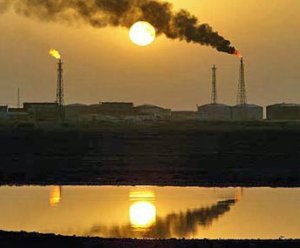
Dubai is a palace of excess and contradition. It is a mushroom that paradoxically bloomed under the whithering rays of the sun. But the leadership of the UAE is a lot smarter than anyone in America today. From today’s New York Times:
[The UAE’s] new investment [in renewable energy] aims to maintain the gulf’s dominant position as a global energy supplier, gaining patents from the new technologies and promoting green manufacturing. But if the United States and the European Union have set energy independence from the gulf states as a goal of new renewable energy efforts, they may find they are arriving late at the party.
The irony that the most wasteful and oil dependent part of the globe should be on the cutting edge of green energy is unremarkable next to the ambition — characteristic of the Gulf states — to go all the way all at once. Consider Masdar City, a planned community outside of Abu Dhabi that claims it will have a zero-carbon footprint. Even though skeptics doubt this claim, it is notable not for its complete success in execution, but for its audacity.
According to the Times article, Qatar has invested $225 million into a British research fund, and Saudi Arabia has invested untold millions into American universities, including $25 million for Michael McGehee an associate professor at Stanford, to develop cutting edge technologies. That is fifty times the amount invested by Western governments or industry.
Finally, the Times tells us Masdar City “goes beyond creating new materials and is in fact exploring a new model for urban life.” To wit: “The city will have no cars; people will move around using driverless electric vehicles that move on a subterranean level. The air-conditioning will be solar powered.” As a New Yorker I take exception to this. After all, we also have subterranean electric cars that move people around. It’s called the subway. If only the city, state, and federal government could get their posteriors and capitals wired together they could see that a massive investment in the New York City subway is a necessary good faith effort to putting America into the 21st century.
It’s true. These guys really rock. If you’re in Dubai, they’re at the Seaview Hotel in the Marine bar. (Sorry if the video resolution is crappy. It’s Youtube’s fault. I’m working on improving it.)

Photo by Tina Fineberg for The New York Times
Though this article in the New York Times is feel-good real estate porn, it is also anecdotal evidence that urbanizaton might reverse the sixty year trend of suburbanization. The reasons Keyes and Woods give for moving back to the city sound like the mantra of the post baby boom, urbanist ethos.
In the summer of 2006, [Keyes and Wood] sold the Brooklyn house to friends for $2.075 million and moved to a five-bedroom colonial, circa 1920, in Maplewood, N.J. Their house there cost $930,000. Compared with other places, Maplewood, which reminded them of New England, felt more like a community and less like a bedroom suburb.
Their Brooklyn taxes were around $3,500 annually, but in Maplewood they were paying around $23,000. The good schools, they thought, would justify that amount for a family with several children, but “we could put Jillian in a really nice private school for that,” Mr. Wood said.
And Maplewood didn’t really feel like a community after all. “We had wonderful neighbors,” Mr. Wood said, “but it wasn’t the same as being in the city. Everyone got in cars and went somewhere. The only people you saw were running down to the train or jogging or walking their dog.”
Mr. Wood works from home but travels often. Ms. Keyes, alone with Jillian, now 4, felt isolated. “I underestimated how important the sense of community we developed in Brooklyn was,” she said. “I missed the restaurants and the green markets.”
Taxes are paradoxically lower in the city than in the ‘burbs; the city has more community, and this is largely due to pedestrian traffic, public transportation, and population density; prices of homes are falling in the suburbs as people become desperate to get out. This last point is of particular interest. Though gas prices may fall so far that driving is not a crushing expense and will not be as important a motivating factor moving people to the cities as it was last summer, the housing contraction may take its place as a motivator. The “broken windows” syndrome that drove whites from the urban core from World War II to the end of the Cold War may now drive them from the suburbs as unsellable houses become squats, derelict, or hideouts for crime. The process may be viral, first infecting the last, big, overdeveloped exurbs, then making its way into older suburbs until they too seem like ghost towns. If it is, the next fifty years will look considerably different than the last fifty years.
That will have an effect on politics too. The rural myth, enabled by the automobile and the suburb, that made Sarah Palin seem like a wise choice to Karl Rove will change dramatically. Will it disappear? Probably not. But it will change, and that will change what sort of candidates the rural right chose to represent them.

"PARTYS OVER" graffiti, NYC subway, October 2008
The editor asked me to write more about NYC and less about national politics. So this is it.
We’ve all heard about the vices of city living: gangs, drugs, AIDS, high taxes, poor schools, crowded apartments, and no place to park. What are the virtues of urban living?

This is a jazz band taking a break at Astor Place in Manhattan. It is a perfect example of the spontaneous and organic enrichment of life that happens in a pedestrian oriented city like New York. By interacting with people on the street you encounter culture that broadens your horizons while you’re on your way to work. And it’s completely free — unlike books on tape.

The New York Times published an editorial yesterday that argued against a $1 surcharge on taxi fares due to the spike in gas prices. They note that there are a few hundred hybrid vehicles in the 13,000 taxi fleet, and that the entire fleet will be hybrid by 2012. The question is, why aren’t all yellow cabs hybrid now, and why won’t we have a fleet of electric taxis by 2012. The answer undoubtedly has to do with politics and the T&LC. Cultural Capitol will look into the matter and report more later!
(Editor’s note: This is the first post by Cultural Capitol writer J. D. Oxblood.)

On Dining with Strangers
By J.D. Oxblood
I live on a small island off the coast of the United States of America. That may be technically untrue, but it’s more true than the truth. I live on the Island of Long, in a small corner that is vastly different from the rest of the island and—like the neighboring island of Manhattan—the rest of America.

This is a story, like all New York stories, about what makes us different, if not exactly special. We live in tiny, tiny apartments and pay anywhere between a third to half of our income on rent. This is alarmingly obvious to New Yorkers, but if anyone’s reading this out in flyover country (that’s right, I said it) read that sentence again. It’s insane if you really chew it over, and yet we do it, year after year. And as I was recently reminded whilst dining with out of town guests, it’s always all about the rent. As my visitors were wondering why we were paying $15 for a cocktail, I noted the address: we’re half a block from Rockefeller Center. Guess what—while the cocktails are weak, the service is crap, the décor is overdone and like something some rube from the suburbs would call “so New Yorky”—these people have to pay the RENT.

I saw one of the waterfalls erected by Olafur Eliasson and the Public Art Fund last night. For a nicely literary review check out Roberta Smith’s article in the New York Times. Sadly, my camera was inadequate to capture the beauty of the art.
A city not only attracts all kinds — people from outside the country who have come to trade or build their fortune, people from the countryside who want the same — it encourages people to develop their persona more actively than in their home community, where the self is developed mostly through the expectations of others rather than from a desire to be seen. Or, to put it another way, in a city of millions of inhabitants, it’s easy to be invisible, and if you want to stand out you really have to work on it.
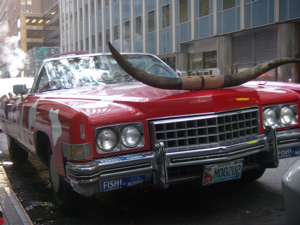
This cowboy drove his herd down from Maine. The car was parked on 43rd between Lexington and 3rd, so maybe he was rustlin’ up some shares at a stock broker’s ranch. Yippie-kai-yay, dude. Yippie-kai-yay.


Some friends and I ate lunch at Habana Outpost on the corner of Fulton and South Portland St last Friday. It was a beautiful day to sit outside and have a margarita.

The decor is fantastic. I love the combination of Southern Spanish / North African elements with Catholic, Central American and bricolaged pieces.


Habana Outpost is an “eco-eatery,” which is displayed in several design elements. In the bathroom rainwater runs through copper pipes to feed sunflowers and other green plants. In the back rainwater is channeled to rows of herbs that patrons are invited to smell and identify.



Habana Outpost is a perfect example of the New Urban Aesthetic that seeks to enhance the already ecologically advantageous elements of urban dwelling with environmentally conscious architecture. And the food is delicious.
 culturalcapitol.com