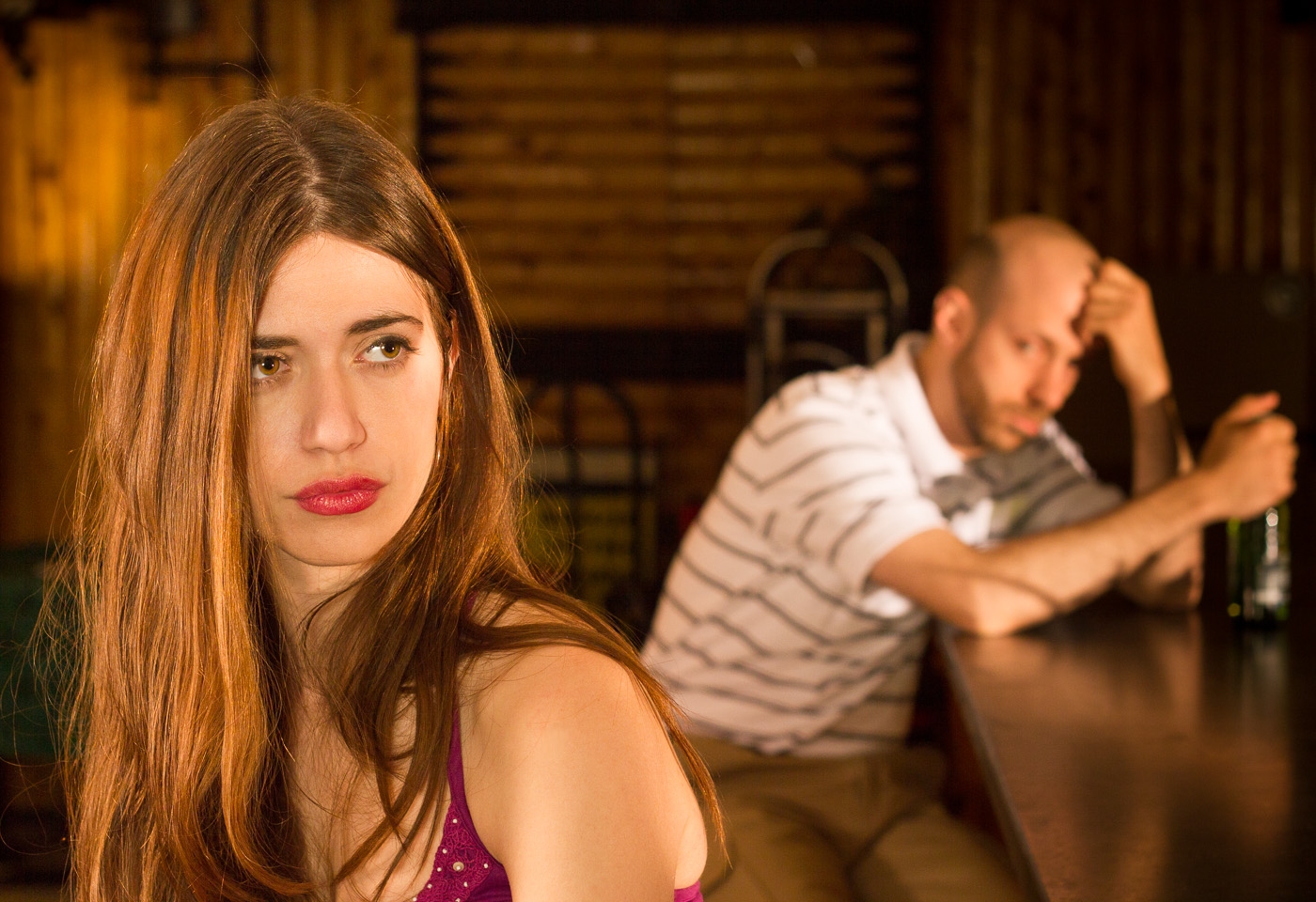
Brandon Walker and Erin Cronican as Beane and Molly

Brandon Walker and Erin Cronican as Beane and Molly

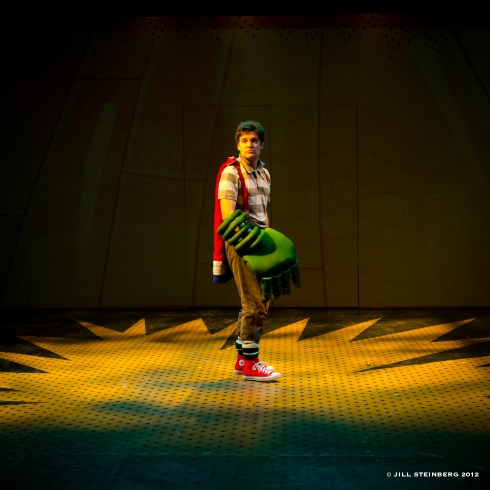
Why do birds sing so gay? Because they’re fools. Besides, what else are you going to do? If the mind is its own place, and in itself can make a heaven of hell, a hell of heaven, then why not choose happiness over misery? Beane has been in a minimalist hell of his own creation his whole life. He owns one cup, one spoon, one jacket, one hoody, and an overcoat. He lives in a one room apartment with one lamp (bare bulb), one table, and one toilet. He works in a toll booth all day and has hallucinations induced by solitary confinement at night. He also has one sister, Joan, and one brother-in-law, Harry, who are cynical and world-weary, which is to say they don’t have much imagination, curiosity, or joie de vivre. They are his clueless caretakers, the sort who invite him over for dinner then give him a psychology test from the back of a magazine to show they care.

Read the rest of this entry »

Matthew Foster and Michael Poignard in Australian Made Entertainment's production of "Speaking In Tongues"

Matthew Foster and Michael Poignard in Australian Made Entertainment’s production of “Speaking In Tongues”

The first scene of Andrew Bovell’s 1996 play Speaking In Tongues features four characters — two men and two women — who share one dialogue about marital infidelity. All four, dissatisfied with their partners, pick up a stranger in a bar to consummate an adultery. It turns out that the four have randomly cheated on each other with each other, though the two couples are strangers to each other. The quartet share the same conversation, speaking the same speeches simultaneously. Chance — randomness, serendipity, long odds — only seemingly operates on these four; in fact, the rigid structure of the first act merely suggests coincidences that are relentlessly denied by the tight framework of dramatic irony.

Read the rest of this entry »

What do you have to do to get noticed around here? It seems like all of us in the theater biz are permanently tortured by this question. Directors, actors, dancers, singers, designers of all varieties, not to mention writers, press agents, and critics, all clamor for a look, a nod, a glint of recognition in the eyes of Our Audience, even if that’s just some schmuck transferring trains at Union Square.

(You don’t think writers schlep their merch in the subway? Clearly you never met Donald Green.)
Read the rest of this entry »

“Thou art thy mother’s glass, and she in thee / Calls back the lovely April of her prime.” ~ W. Shakespeare.

It’s not easy to lug a stroller down the subway station stairs, and it is definitely difficult to hold a screaming baby while pressed cheek to jowl with eight million fellow urbanites. Raising a kid in the city has probably never been carefree, but in The Big Apple it’s not only a headache, it’s also expensive and socially limiting. Susan Bernfield’s play Barking Girl is a sweetly lyrical meditation on one woman’s experience of motherhood that takes a philosophical view of the many privations and rewards of procreation in New York.
Read the rest of this entry »

A Twist of Water is a family drama with twists, but not the kind you think. Plot twists, though there are a couple, are not nearly as important as the bending and twisting of conventional social roles — identity bending, if you will. The broadest theme of the play is identity — how it is created, how it empowers, and how it limits and disempowers. Identity, layered like lacquer on a fine musical instrument, is bent and shaped by the playwright Caitlin Montanye Parrish and her creative partner and the play’s director Erica Weiss to give the story an affecting cultural resonance. But the appeal of this production lies not so much in its burnished finish, as its timeliness, which is, perhaps, a simple twist of fate.
Read the rest of this entry »

What scares you the most? Vampires? Zombies? Hurricanes? Horror may have a face — a hockey mask, a visor made of human skin, or the horrible burn scars produced by the fires of Hell — or it may be a place, like the Overlook Hotel or the Bermuda Triangle. UglyRhino’s production of “Gowanus ‘73” gives you an interactive tour of the terrifying underworld around the Brooklyn Lyceum thirty years ago: party girls and gangsters, prostitutes and pimps, and the ghosts of human flotsam and jetsam that beat softly against the wooden pilings of the canal’s embankment.

Read the rest of this entry »

Caitlin Johnston, Nadia Sepsenwol, and Mariana Newhard as Irina, Maria and Helen (Photo: Samantha Walsh)

To some extent all theatrical performance is translation. The author — the person with an original idea — puts words on the page, and the performers, including the director, the actors, the design team and the techs, translate those words from page to stage. In the case of The Great Plays of Western Culture, the play may have been written in a language folks in the audience can’t understand, in which case the play must be literally translated. And when the culture the play was produced in is almost as historically alien to the audience as the language, the play must be brought up to date. Christopher Diercksen’s production of By Rights We Should Be Giants is more than just a modernized translation of Chekhov’s Three Sisters however; it is an attempt to rise above translation and totally reimagine the play, from alpha to omega.

Read the rest of this entry »

Bryce Henry as “Maggot” (Photo by Jonathan Shaw)

In 1968 Philip K. Dick asked if sentient machines had feelings in the title of his book Do Androids Dream of Electric Sheep?  Adam Scott Mazer’s Oedipal fantasmagoria Motherboard asks the related question “do gynoids lactate electrolytes?” As the pun in the name implies, Motherboard posits technology as humanity’s nourishing mother. Tech is not just a tool that we created and control, it makes us human. And like all bad children, we get into big trouble when we talk back to mommy.

Read the rest of this entry »

Inline image 1

Love is risk. That tagline is the premise of Kerry Vaughn Miller’s new production of Alan Bowne’s 1987 play Beirut.
Read the rest of this entry »

Michael Crowley (as Beethoven) and Michael Rau (photo by Rick Ngoc Ho)

The elaborately named Song of a Convalescent Ayn Rand Giving Thanks to the Godhead (In the Lydian Mode) is a play constructed of twenty-four comic skits, self-consciously styled “variations,” that aspire to something like fugue structure. This is not a happy accident of “negative capability”: the show’s writer, Michael Yates Crowley, constructs the analogy between musical formalism and dramatic form explicitly and self-consciously throughout the performance. That analogy is, in fact, the grounds for the argument of the play, which is that Romantic art only gains transcendence when tempered by philosophical Stoicism.

Read the rest of this entry »

Though people like to say money is the root of all evil, you won’t find many who will refuse it to save their souls.

Loretta and Frances, two community care workers in Belfast, are paid by the state to take care of the old and infirm. Though their wages are low and the work is draining, they are the only two who stand between Davy, an old-age pensioner, and isolation. After they wipe his bum and put his meals-on-wheels in front of him, Loretta gets his weekly pension from the ATM, and Frances places his weekly five pound bet on the ponies.

Read the rest of this entry »

“Gee whiz Rocky! There’s too many of them!” says Chip Skipper, best pal and lieutenant cheerleader for the plucky crew of the X-1 rocketship. “Easy does it, Chip! We’ll get out of this,” says Rocky. (And they do. They don’t call him Rocky Lazer, Captain of Space for nothin’!)

Read the rest of this entry »

Tender Napalm, a new play by the East London playwright Philip Ridley, is as close as theater is likely to come to the Platonic Ideal of a Pure Play. Its set is a rectangle on the floor; the lights are static; there is no music; the costumes look like comfy clothes the actors chose themselves. And I hope they did! Because the real (only) visual element of this “theater” is the acrobatic athleticism displayed by Blake Ellis and Amelia Workman, who play “Man” and “Woman” respectively. The same artistic impulse forms the drama around two archetypes (note the characters’ names). You might categorize the dramatic conflict as a “battle of the sexes,” which would not be incorrect. But in truth, “sex” is just a way of saying “two complementary but diametrically opposed positions.” And Ridley makes a point of telling us Man and Woman can (and do) switch places very easily.

Read the rest of this entry »

Mrs. and Mr. Pontellier

The  Brooklyn Lyceum used to be a public bath house, one of those grand, old public works erected during the borough’s Gilded Age efflorescence. It was left derelict during the 70s, and now it is a cavernous, unfinished space with exposed brick walls, thirty-foot-high ceilings, and interior structures built of plywood and wood screws covered in cheap bluish primer. Functionally it’s like a page in a Medieval manuscript scraped clean of its original writing, though incompletely erased marks of its past peep through. The whir of the ceiling fans sounds like crickets, and the lights flicker like gas lamps.

Read the rest of this entry »

Erin Cronican and Brandon Walker in “The Lover”

In New York City it can seem like the audience is an accessory to theater. Plays with big name stars charge a king’s ransom to sit in the back row of a giant theater, and you had better bring your binoculars if you want to see that movie actor strut and fret his hour upon the stage. Every restaurant in Manhattan has a cast of waiter/actors ready to slip you a postcard with info on how to see a burlesque or magic show, a comedy club, an art installation, a theater festival, or a musical act in any genre that tickles your fancy. Usually when you get there the art is so high concept you want to scrub your brain with Kardashian reruns just to get back to normal. Did they create that work of “art” for you, or did you just pay $15 to bear witness to their artistic genius?

Read the rest of this entry »

Welcome guest reviewer Tom Jacobs!

We don’t really have a word for the ancient Greek arête — best translated as “virtue” — and it’s a damn shame.   The humble, ceaseless, and impossible but necessary pursuit to achieve something like earthly perfection or at least self-improvement.  This seems like a pre-modern term, but of course it isn’t.  A movie like Broke* provides a case study for thinking about it.  This is a story about the kind of virtue and grace necessary to avoid succumbing to the time-clocked, bottom-line, cut-to-the-quick efficiency that seems to be darkening the land at the moment.

Read the rest of this entry »

Miss Lilly praying for a bone from Heaven

What is it with playwrights and puns? Elaborate, mind-bendingly cute puns — they just love ‘em. In Bekah Brunstetter’s new play Miss Lily Gets Boned the biggest, most playwritingest pun is eleven feet tall and requires three adult men to operate. That’s how big it is. And you know the secret of big puns? If they get big enough they turn into metaphors.

Read the rest of this entry »

The mind is its own place, and in itself
Can make a Heaven of Hell, a Hell of Heaven

Paradise Lost Book I, 254-255

In Seth Panitch’s hilarious new play Hell: Paradise Found, a satirical send-up of conventional religion and  morality, Simon Ackerman (Thomas Adkins) walks into an office to find himself in an interview with the devil (played by the playwright Seth Panitch). Simon is confused and a little indignant. After all, he never broke the rules at any time during the span of his completely predictable life. He got a respectable job, a wife, a 401(K). He should spend his golden rest-of-eternity years on the golf links in the sky, playing everlastingly on soft greens at three under par.

Read the rest of this entry »

Do androids dream of electric sheep? Or to put the question the other way, are humans just extremely complex machines? If we are machines, is the ability to manipulate others (i.e. politics) a purely technological problem? More importantly, is there something outside technology? Theater Reverb’s new show initium / finis poses these questions through a pastiche of classic sci-fi noir movies and cabaret style performance framed by a mash-up of Hindu and Christian myth. But rather than plumbing the depths of the mystery to find its bottom, they multiply it, refracting it through stagecraft, creating an atmosphere mixed with the angst of modernity or/and the awe of religion.

Read the rest of this entry »

Brian, Quinn, and Stu in the Man Cave

Three guys, three drinks, three acts: Virilia, Virility, Visectomy; beer, schnapps, whiskey; Brian, Stu, and Quinn. Three dudes, buds, bros from the old skool, do what bros do best — torture each other in a never ending test of masculinity and boner bona fides.
Read the rest of this entry »

Anarchist Occupiers and The Hipster Cop

It is proverbial to say the city is naked and filled with eight million stories. The Bad and the Better, playing at The Peter Jay Sharp Theater on 42nd street, is detective noir set in contemporary New York City that tries in scope and imagination to reach that magic number. Twenty-six (count ‘em) actors from the downtown theater troupe The Amoralists tell a story of corrupt cops, corrupt politicians, corrupt revolutionary anarchists, and more than one moll with a heart of gold, making you feel as though eight million isn’t actually all that many storylines.

Read the rest of this entry »

Hannah Cheek as Ronnie Regina

2012 is half over, and so far it looks like the apocalypse has been averted. In typical human fashion we have invited our destruction to sit with us at the table; and just at the last minute, just when it looked like destruction was going to have us for dinner, we trixy rabbits slip out of its noose and high tail it to the mountains, forests, and deserted places to do what bunnies and humans do — repopulate the earth.

Read the rest of this entry »
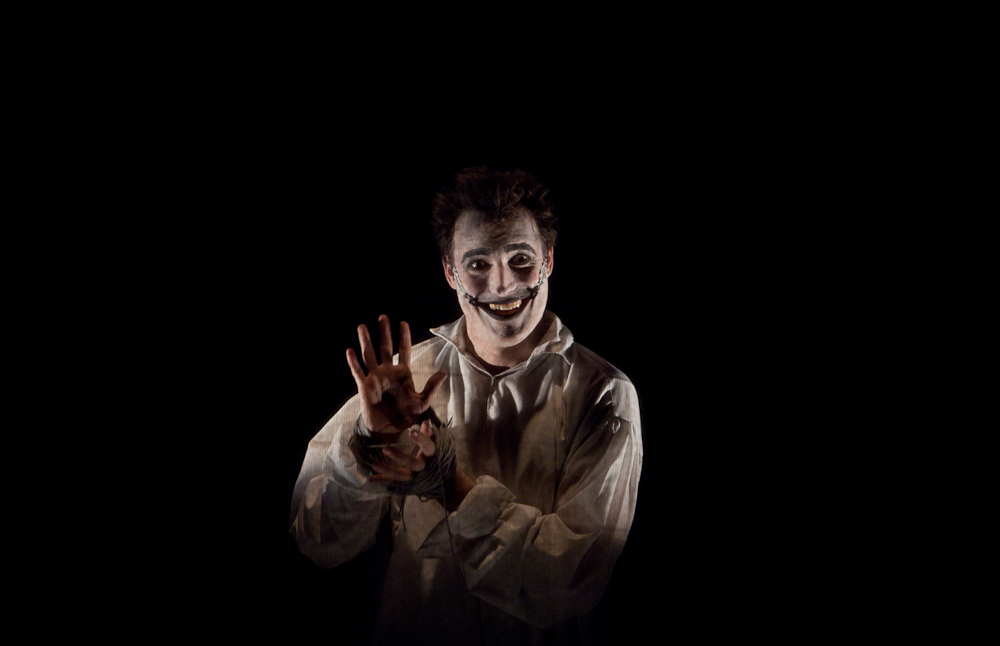
Trescante receives a letter from the government

Michael Bradford’s play Olives and Blood is a memorial, a testament to the aftereffect of Spanish poet Federico Garcia Lorca who was allegedly assassinated near his childhood home in Granada by fascist militiamen in 1936. It is a hymn to the power of dramatic poetry to endure and overcome the prosaic power of angry men and sclerotic social conventions. Garcia Lorca’s favorite word for that power is duende: that which “gives you chills, makes you smile or cry as a bodily reaction to an artistic performance that is particularly expressive.” In Olives and Blood Garcia Lorca himself is closer to the original meaning of duende — a goblin, elf, or imp. He is a spirit, a ghost of the creative energy that operates through perfect metaphor, shaping formless experience into memory and then art.

Read the rest of this entry »

Contributed by Robin Elisabeth Kilmer

Modern renditions of Romeo and Juliet aren’t rare, but remakes set in a taxi garage are. Such a setting puts Empirical Rogue Theatre Company’s rendition in the same borough as the West Side Story and Bhaz Llurmann’s movie version of the Bard’s most popular play. There are glaring differences, however, that place it in a neighborhood of its own.

Read the rest of this entry »

Cultural Capitol welcomes our guest columnist Keith Meatto! Check out is other work at Frontier Psychiatrist.

Beethoven and Quasimodo team up to write a musical interpretation of a cryptic stage direction in Anton Chekhov’s play The Cherry Orchard, but both men are deaf and near death, Beethoven is senile, and the project ends in failure. Such is the setup of The Hunchback Variations, based on Mickle Maher’s play with music by Mark Messing, a “chamber opera” that had a successful run in Chicago and opened June 1 at 59E59 Theaters in New York.

Read the rest of this entry »
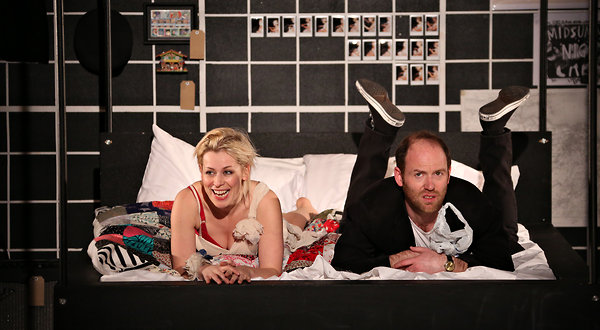
Slim and Cavale observe the lobster boy’s ablutions

“I hope I die before I get old.” – Roger Daltrey

Slim and Cavale are holed up in an apartment in the East Village. If you want to find them, ask the lobster boy standing on the corner of 1st Ave and 2nd street. He’ll give you a fortune cookie with directions to their lair.

The folks at One Old Crow Productions have transformed a studio apartment into a studio theater for their production of Sam Sheppard and Patti Smith’s 1971 one act Cowboy Mouth. Stepping through the door is very nearly like stepping through a forty-year time warp into the gritty, mythical, heroin soaked New York of punk rock lore. Alas, the Mars Bar may be no more, but the smell of the Ramones lingers in the peeling paint above Lucky Cheng’s.

Read the rest of this entry »
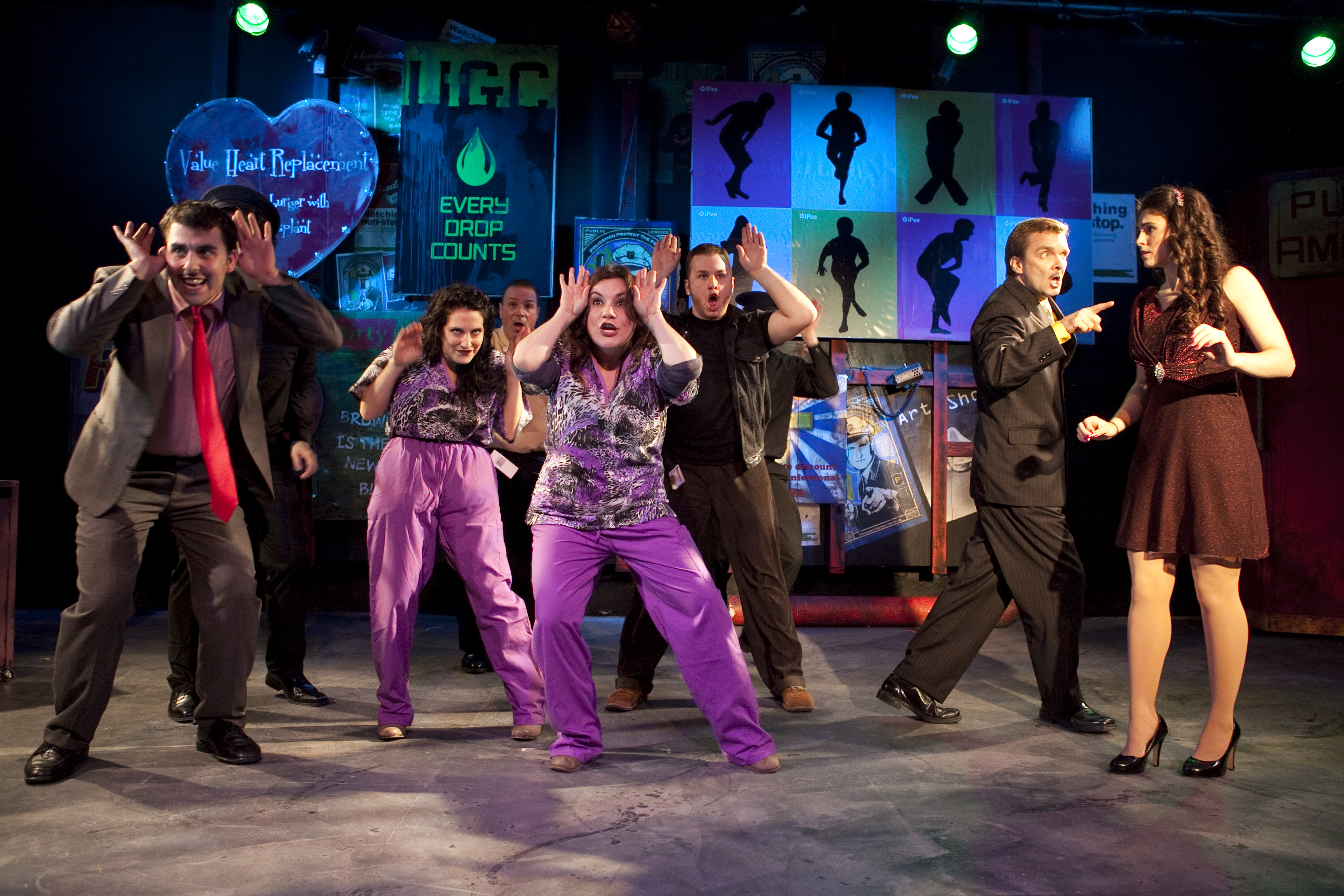
Glamor! Intrigue! Vicious passions and overwhelming venality! Picture the scene: a beautiful boy plays with the hearts of three proud, handsome ladies. This isn’t “The Bachelor,” or “The Real Housewives of Orange County,” though the characters in this show hail from nearby the ancestral lands of the Kardashians. This reality show took place thousands of years ago on the hills in the shadow of Mount Ida, and instead of a “first impression rose” this Ganymede has a golden apple for the fairest of them all.

“Judge Me Paris” is Austin McCormick’s take on “The Judgment of Paris” (1700 anno domini scriptum) a courtly masque in the tradition of Ben Jonson and Inigo Jones with libretto by William Congreve and music by John Eccles and John Weldon. Congreve, who penned the famous phrase “Heav’n has no Rage, like Love to Hatred turn’d, / Nor Hell a Fury, like a Woman scorn’d” in 1697, was the English master of “manners” comedy – a genre that emphasizes courtly intrigues and affairs of the heart. Eccles and Weldon’s music is high baroque, trilling and aristocratic. The neoclassical subject matter evokes an age when allegory, history, and rich symbolism were employed to celebrate and exalt sexuality.

Read the rest of this entry »

Christopher Fahmie as hard-boiled private eye Kit Marlowe

What do you get when you take film noir, throw in a heaping helping of classical mythology, and top it off with a dollop of Jacobean conceit? Words that sound like poetry, a trip to the underworld, the brink of salvation, and the depths of despair.
Read the rest of this entry »

David Harrower’s play A Slow Air aims to evoke the feeling of an old song, one that a bar full of drunks will sing in the wee hours. To do that he puts us in the moment when the song becomes meaningful: that smoky local (you know the one) late night, after the bad feelings have come up and been spit out like bile, after the accusations and recriminations, the years of disappointment and confusion, after watching your dreams modified into hopes, and even those hopes contracted to a desire to be left alone.

Read the rest of this entry »
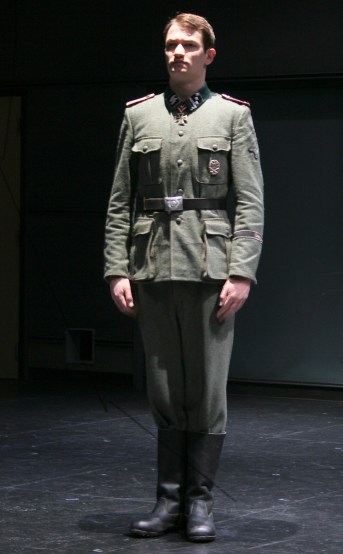
AL Pearsall, Becky Byers, Alisha Spielmann, Nancy Sirianni and Felicia Hudson give birth to a revolution in “Blast Radius”

Blast Radius, the second installment in Mac Rogers’s Honeycomb Trilogy, opens seventeen years after Bill Cooke, All-American Spaceman, returned from a fateful journey. A secret government cabal sent Cooke to scope Mars for terraformation, for they knew our planet was on the brink of environmental collapse and our species on the brink of extinction. But instead of gathering data for a human exodus, Cooke and company discovered an alien race who offered to save the Earth – for a price.

Read the rest of this entry »
Follow

Get every new post delivered to your Inbox.