You are currently browsing the tag archive for the ‘Culture’ tag.
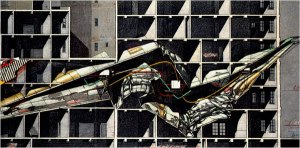
This is a drawing from a NY Times piece on the artistic genius of architects. I know many of you — my friends — are architects. But I have to say, when it comes to raw hubris, not even Richard Cheney can beat an architect (or their groupies).

Ayn Rand

This guy was in his clown suit on the L train between 1st Ave. and Bedford. He looked sad. Sad clown. After a hard day of clowning I imagined he was on his way home to his clown wife and clown kids. Probably in Queens.

(For mah peeps living the bohemian novelist’s dream.)
A Moveable Feast is Hemingway’s memoir of life for the young ex-pats who enjoyed the first blush of American global economic dominance in France after the end of the First World War. Though he and Gertrude Stein, Ezra Pound, and John Dos Passos complained about being poor and put on a show of living a bohemian lifestyle, they were all supported by the strength of the US economy and money sent to them from the states. The fact that the French franc was close to trash compared to the dollar supported their artistic ambitions.

This now infamous video is proof that the surveillance state cuts both ways. (Thanks to Shawn for pointing it out.)
My sympathies are obviously with the bikers. For that matter, I never liked cops much. Their job is to go out cruising for trouble. Bad news in my opinion. The only people who should be cops should be the ones who pass a rigorous exam on ethics. But then there wouldn’t be many cops. Or politicians probably.
Bikes need to displace cars in the modern city — absolutely. They need to be sacred cows, so long as they don’t make a habit of running over pedestrians, who are by far the most sacred form of life on and in the street. And cops who make asses of themselves and abuse their power on video should be canned — immediately, no questions asked.

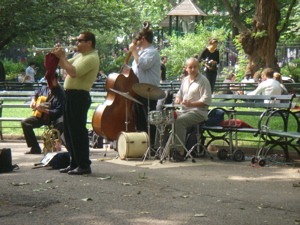
This is a jazz band taking a break at Astor Place in Manhattan. It is a perfect example of the spontaneous and organic enrichment of life that happens in a pedestrian oriented city like New York. By interacting with people on the street you encounter culture that broadens your horizons while you’re on your way to work. And it’s completely free — unlike books on tape.
By J.D. Oxblood
Caught the Monday night again at Public Ass. (“Public Assembly is just a stupid name. It will heretofore be referred to, in these pages, as Public Ass. Suits my idiom.) It’s nice to see that in spite of all the gentrification, the old Billburg spirit is alive and well at Public Ass—the bartenders suck. Too cool for school, way too cool to actually pour a drink or care about tips. Amen, my brethren
The less said about Jonny Porkpie’s Fresh Faces Showcase the better — although WordyGirl’s diss on the U.S. of A. was … something. And at midnight I had to get the hell out of there and get me some up-close-and-personal T & A.
😉
Consequently I couldn’t stick around for GiGi’s Monday Night Blue, so so all you’re gonna get is the highlights of the main event. Deal.

Monday, July 7, 2008 marked the opening night of the new Monday Night Burlesque at the Performance Space Formerly known as Galapagos. The act to christen the space, or, to “embooben,” as Nasty Canasta put it, was no other than the now super-famous Julie Atlas Muz. She came on in classic black — eyes big as swimming pools complete with bikini-clad pleasure models lounging with Mai Tais — lost her black dress in under a minute, sucked off a rose in fellatiatic splendor, spat out the petals, spilling down her bare bosom, and before anyone could quite check the turgidity of his member, was crawling across the bar to bathe herself with a bowl and a bar of soap, complete with avid pit and crotch scrubbing. No one does nudity with laughter better than the Muz. She finished with a bottle of vodka upended over her entire body and I half-thought she was going to set her entire figure on fire. Let me be the one to tell you, folks: Julie looks hotter now than she did when I first saw her naked, 8 years ago. That’s some serious deal with the devil, and I think he got took.
(Editor’s note: This is the first post by Cultural Capitol writer J. D. Oxblood.)

On Dining with Strangers
By J.D. Oxblood
I live on a small island off the coast of the United States of America. That may be technically untrue, but it’s more true than the truth. I live on the Island of Long, in a small corner that is vastly different from the rest of the island and—like the neighboring island of Manhattan—the rest of America.

This is a story, like all New York stories, about what makes us different, if not exactly special. We live in tiny, tiny apartments and pay anywhere between a third to half of our income on rent. This is alarmingly obvious to New Yorkers, but if anyone’s reading this out in flyover country (that’s right, I said it) read that sentence again. It’s insane if you really chew it over, and yet we do it, year after year. And as I was recently reminded whilst dining with out of town guests, it’s always all about the rent. As my visitors were wondering why we were paying $15 for a cocktail, I noted the address: we’re half a block from Rockefeller Center. Guess what—while the cocktails are weak, the service is crap, the décor is overdone and like something some rube from the suburbs would call “so New Yorky”—these people have to pay the RENT.

I saw one of the waterfalls erected by Olafur Eliasson and the Public Art Fund last night. For a nicely literary review check out Roberta Smith’s article in the New York Times. Sadly, my camera was inadequate to capture the beauty of the art.
Construction on the fountain in Washington Square Park continues. It is being moved some feet to the right to make its center align with the arch and fifth avenue. To know more about the controversy behind the “redesign” of the park check out Washington Square Park blog.
The park’s history is the struggle of American urbanization writ small. Since the time of Robert Moses, anti-urbanists have tried to break it up or privatize it. Moses succeeded in extending 5th Ave. through it, and wanted to widen LaGuardia place to make it a thoroughfare, but Jane Jacobs and Shirley Hayes blocked the plan. The street was closed and Moses, who is legendary for bulldozing over neighborhood residents’ objections, was successfully checked for the first time. Ric Burns’s New York documentary is also a great place to learn more about Moses and the anti-urbanists.
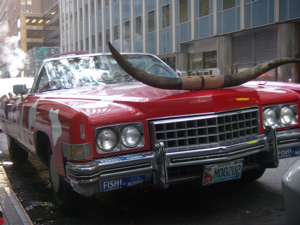
A city not only attracts all kinds — people from outside the country who have come to trade or build their fortune, people from the countryside who want the same — it encourages people to develop their persona more actively than in their home community, where the self is developed mostly through the expectations of others rather than from a desire to be seen. Or, to put it another way, in a city of millions of inhabitants, it’s easy to be invisible, and if you want to stand out you really have to work on it.
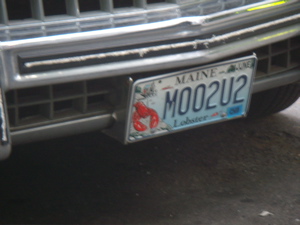
This cowboy drove his herd down from Maine. The car was parked on 43rd between Lexington and 3rd, so maybe he was rustlin’ up some shares at a stock broker’s ranch. Yippie-kai-yay, dude. Yippie-kai-yay.

I went to check out Oskar Eustis’s production of Hamlet last night at the Delacorte Theater in Central Park. The skies threatened rain all day, and finally delivered just as the play was about to start. It misted more or less heavily until I left, which was thirty minutes into the show.
I kind of feel bad for the actors. They’re the ones who have to suffer the brunt of shame when things go bad. On the other hand, a sense of self-preservation is necessary in all living things. If you can tell things aren’t going right, it’s your responsibility to take up the slack. And Shakespeare isn’t boring! If people are bored the text is not the problem — it’s the production. Hamlet is, in my opinion, the hardest role — ever — for an actor. Hamlet’s indecision has to be rendered by an actor with incredibly strong instincts for nuance and timing or it comes across as mere confusion.
The obvious and avoidable screw ups — when Hamlet forgot his lines in hist first scene, or when Polonious (played by Sam Waterson) got so off track in Act II, scene i you could hear crickets chirping — that I can blame on the weather. But some problems were in the production concept, and those problems aren’t going away even after the rain clears up.
 Hamlet is definitely not a he-man or a “decider“. When Claudius tells him in the second scene that his grief for his father is “unmanly” he tells us, the audience, that Hamlet is going to have a crisis of heroism. I was no fan of Mel Gibson’s Hamlet for this very reason: Hamlet is a sensitive boy. But casting Michael Stuhlbarg as the dithering Dane made Hamlet into Alvy Singer, a neurotic bumbler who tosses out one-liners like a borscht belt comedian.
Sam Waterson played Polonius, and as I said above, the rain may have had something to do with his inability to deliver his lines. It could also have been because Richard Easton was originally cast for the part (though in the program Waterson credited as Polonius). Did they have a last minute personnel switch-up? Is this a sign that Eustis’s ship has leaks?
The biggest problem with the show was the direction, which is a little surprising considering Eustis’s reputation. All the actors from the bit-player guards to our hero decided to convey the intensity of tragedy by yelling, from the first scene where Francisco and Bernardo see the ghost to Hamlet’s first soliloquy. If there is one iron-clad rule that all directors who tackle Shakespeare must follow, it is to let the poetry do the work and restrain the actors’ desire to over act. Ironically Shakespeare dramatizes this fundamental truth in Act III, scene ii with the “Speak the speech, I pray you, as I pronounced it” speech:
“Speak the speech, I pray you, as I pronounced it to you, trippingly on the tongue; but if you mouth it, as many of your players do, I had as lief the town-crier spoke my lines. Nor do not saw the air too much with your hand, thus; but use all gently: for in the very torrent, tempest, and—as I may say—whirlwind of passion, you must acquire and beget a temperance, that may give it smoothness. O! it offends me to the soul to hear a robustious periwig-pated fellow tear a passion to tatters, to very rags, to split the ears of the groundlings, who for the most part are capable of nothing but inexplicable dumb-shows and noise: I would have such a fellow whipped for o’er-doing Termagant; it out-herods Herod: pray you, avoid it.”
Pray you, Mr. Eustis, tell your actors this. They start the play by shouting, and have no other means to increase the dramatic tension than by increasing the volume of their voices.

I encourage all bored transit riders, art students, hipsters with something to say, and people with Sharpies to try and do a little better than “Woman with a Goatee” at the Lorimer L station. This is not very creative. If you’re going to take the time to marker in a goatee, why not add horns? Make her walleyed. But seriously, the best interventions are the ones that use an exacto knife, like Deion and Pillar at the Clinton Washington G station.

The penis graffito is probably the oldest symbol in the world.

BTW, This is a close runner up: ({}).
There are many, many examples of the penis graffito, but for the sake of space (and sanity) we’ll just look at two from the Clinton-Washington G train stop. Both of them seek to impose sexual power on the person in the poster, and the only difference between the two — and it’s a slight one at that — is the gender object of the power.

Poor Moonshadow! He looks happy, but size of that member cannot be very satisfying.
Is it pornography? If it is, what can a concerned citizen do about it? Public decency is absolutely necessary — no one would argue it is OK for men to walk the streets wagging their membri viri at passersby. But how can you stop someone from stamping a symbol of male power on a poster in the subway? You could have the cops check everyone’s bag for Sharpies. Giuliani introduced paint-proof trains to get rid of unsightly graffiti. One rider took the matter into her own hands and attacked the vandals on their own turf:

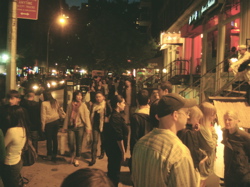
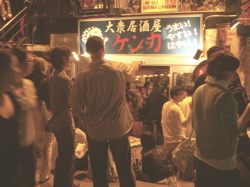
My friend and I went to Kenka, a Japanese restaurant, on Saturday night (23/05/08). Though there was a twenty minute wait to get a table, I enjoyed hanging out on the sidewalk. Last week was Fleet Week in Manhattan, and the streets were jammed with sailors looking for a good time (and maybe a tattoo?). 
Urban density means street life. We sat on the steps in front of Kenka watching the constant flow of people on the sidewalk, listening to conversations and soaking in the richness of the city. Some xenophobes and paranoiacs may feel short of breath on a crowded New York City sidewalk, but there is nowhere safer per capita in the U. S.! Though we were surrounded by different nationalities, ethnicities, and languages, the possible friction from those differences are overwhelmed by the sheer diversity of the street. Not even the scary Japanese mole-monster scared off diners! 
Kenka has great food, and as far as I know it’s very authentic. Either that or the Japanese (Chinese and Koreans) that crowd the restaurant enjoy the Epcot vibe more than the “authentic” KFC you find all over Tokyo and Shanghai. Best of all, Kenka has a cotton candy machine just outside the front door, and they serve a little plastic cup of flavored sugar with your bill instead of fortune cookies. Use a chopstick to capture the cotton candy, and walk away with yummy desert!


Some friends and I ate lunch at Habana Outpost on the corner of Fulton and South Portland St last Friday. It was a beautiful day to sit outside and have a margarita.

The decor is fantastic. I love the combination of Southern Spanish / North African elements with Catholic, Central American and bricolaged pieces.


Habana Outpost is an “eco-eatery,” which is displayed in several design elements. In the bathroom rainwater runs through copper pipes to feed sunflowers and other green plants. In the back rainwater is channeled to rows of herbs that patrons are invited to smell and identify.



Habana Outpost is a perfect example of the New Urban Aesthetic that seeks to enhance the already ecologically advantageous elements of urban dwelling with environmentally conscious architecture. And the food is delicious.

This is from the Lorimer L stop on the Manhattan bound track.
Obviously Kathy Griffin is laughable. That’s why they chose her to host the show. The question is, is a Hitler mustache always funny, never funny, only sometimes contextually funny? It is the easiest form of graffiti, but it must be offensive to the many, many Jews living in Williamsburg. Or is it? The “Void” stamp on her forehead critiques both Griffin’s imbecilic smile and the black smudge on her upper lip. (Could they be the work of the same hand?) The entire picture says “American TV is liberal fascism ultimately void of content.” If we were going to place this on the political spectrum, is this the kind of thing Jonah Goldberg would say? Or Jello Biafra?
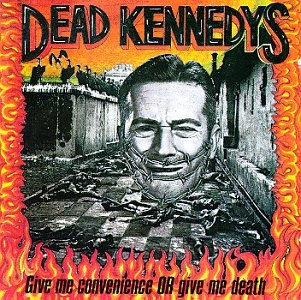
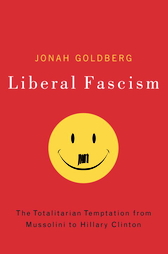
The G train from Metropolitan to Hoyt-Schermerhorn is a laboratory for individual artistic interventions in corporate advertising. This one is on the Smith and 9th street bound track at Clinton-Washington. Notice also the name on the helmet.

Welcome to Cultural Capitol. This is the view from inside the monkey house at the Bronx Zoo.
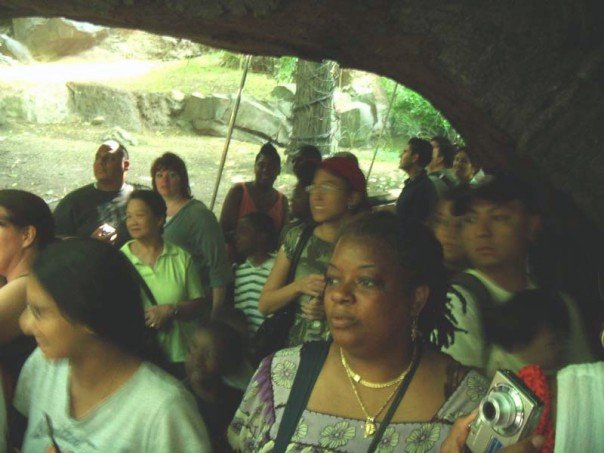
This is what they were looking at:

 culturalcapitol.com
