
You are currently browsing the category archive for the ‘Reviews’ category.

Contributed by Robin Elisabeth Kilmer
Modern renditions of Romeo and Juliet aren’t rare, but remakes set in a taxi garage are. Such a setting puts Empirical Rogue Theatre Company’s rendition in the same borough as the West Side Story and Bhaz Llurmann’s movie version of the Bard’s most popular play. There are glaring differences, however, that place it in a neighborhood of its own.
Cultural Capitol welcomes our guest columnist Keith Meatto! Check out is other work at Frontier Psychiatrist.
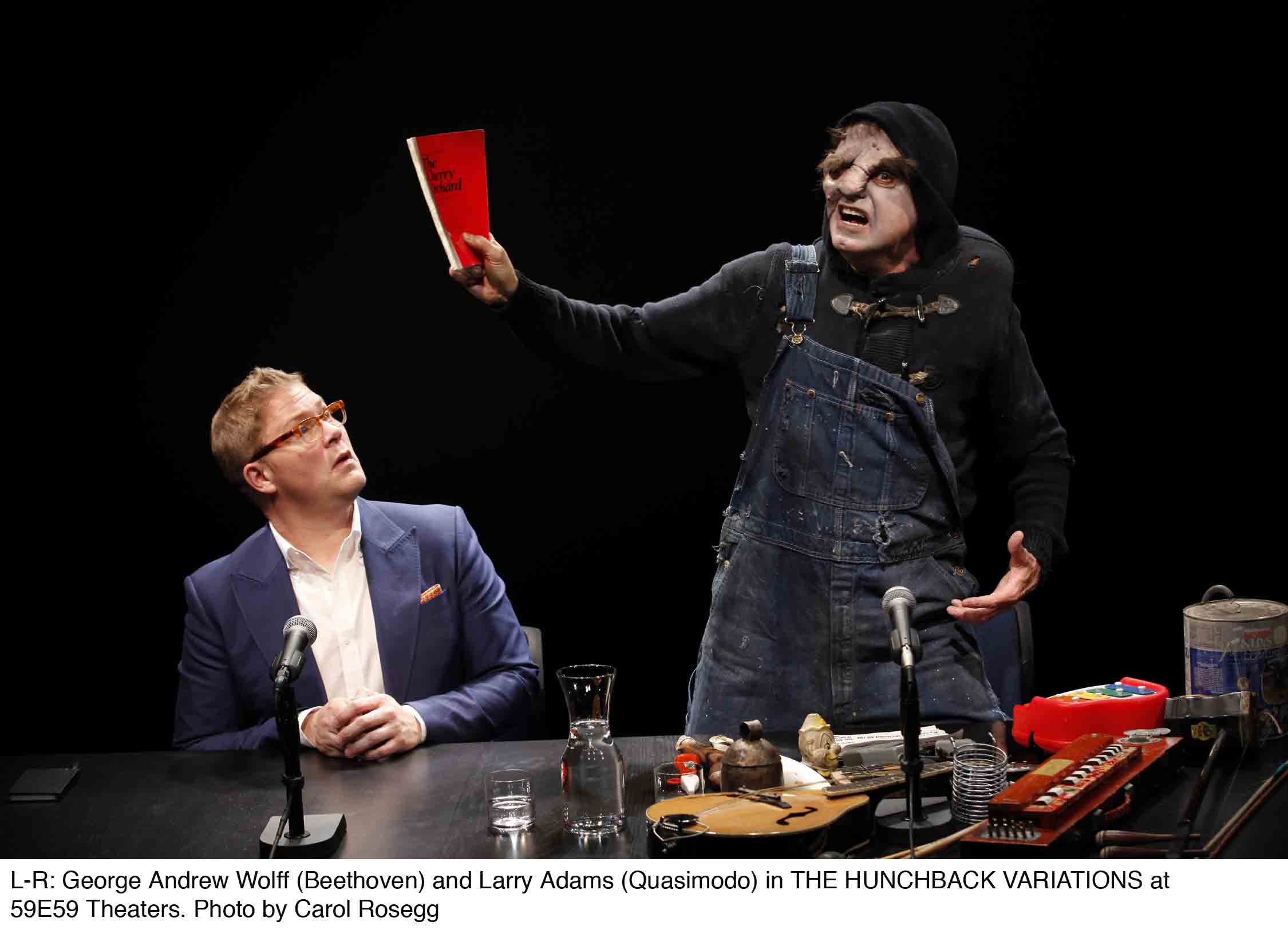
Beethoven and Quasimodo team up to write a musical interpretation of a cryptic stage direction in Anton Chekhov’s play The Cherry Orchard, but both men are deaf and near death, Beethoven is senile, and the project ends in failure. Such is the setup of The Hunchback Variations, based on Mickle Maher’s play with music by Mark Messing, a “chamber opera” that had a successful run in Chicago and opened June 1 at 59E59 Theaters in New York.

Slim and Cavale observe the lobster boy’s ablutions
“I hope I die before I get old.” – Roger Daltrey
Slim and Cavale are holed up in an apartment in the East Village. If you want to find them, ask the lobster boy standing on the corner of 1st Ave and 2nd street. He’ll give you a fortune cookie with directions to their lair.
The folks at One Old Crow Productions have transformed a studio apartment into a studio theater for their production of Sam Sheppard and Patti Smith’s 1971 one act Cowboy Mouth. Stepping through the door is very nearly like stepping through a forty-year time warp into the gritty, mythical, heroin soaked New York of punk rock lore. Alas, the Mars Bar may be no more, but the smell of the Ramones lingers in the peeling paint above Lucky Cheng’s.
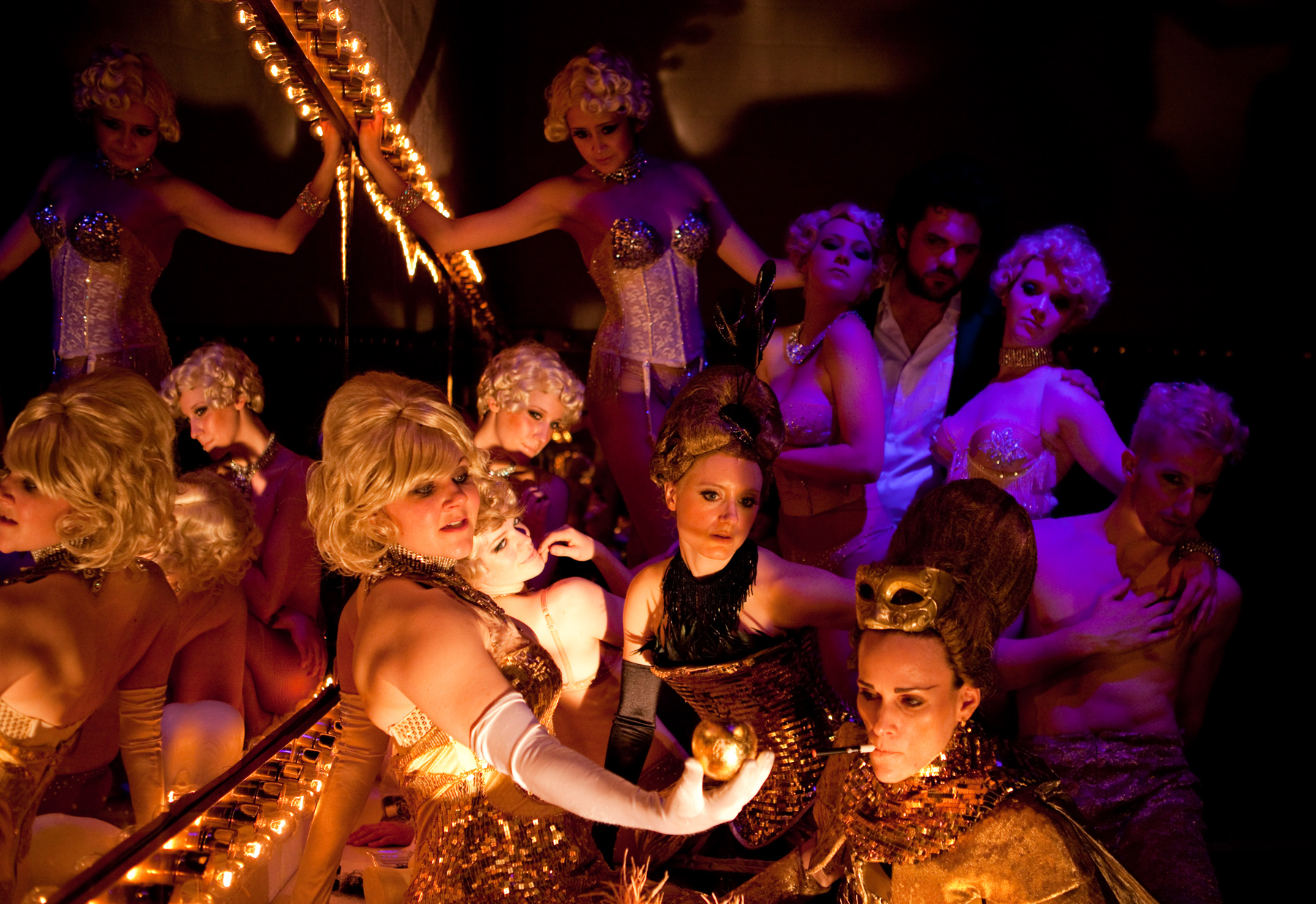
Glamor! Intrigue! Vicious passions and overwhelming venality! Picture the scene: a beautiful boy plays with the hearts of three proud, handsome ladies. This isn’t “The Bachelor,” or “The Real Housewives of Orange County,” though the characters in this show hail from nearby the ancestral lands of the Kardashians. This reality show took place thousands of years ago on the hills in the shadow of Mount Ida, and instead of a “first impression rose” this Ganymede has a golden apple for the fairest of them all.
“Judge Me Paris” is Austin McCormick’s take on “The Judgment of Paris” (1700 anno domini scriptum) a courtly masque in the tradition of Ben Jonson and Inigo Jones with libretto by William Congreve and music by John Eccles and John Weldon. Congreve, who penned the famous phrase “Heav’n has no Rage, like Love to Hatred turn’d, / Nor Hell a Fury, like a Woman scorn’d” in 1697, was the English master of “manners” comedy – a genre that emphasizes courtly intrigues and affairs of the heart. Eccles and Weldon’s music is high baroque, trilling and aristocratic. The neoclassical subject matter evokes an age when allegory, history, and rich symbolism were employed to celebrate and exalt sexuality.
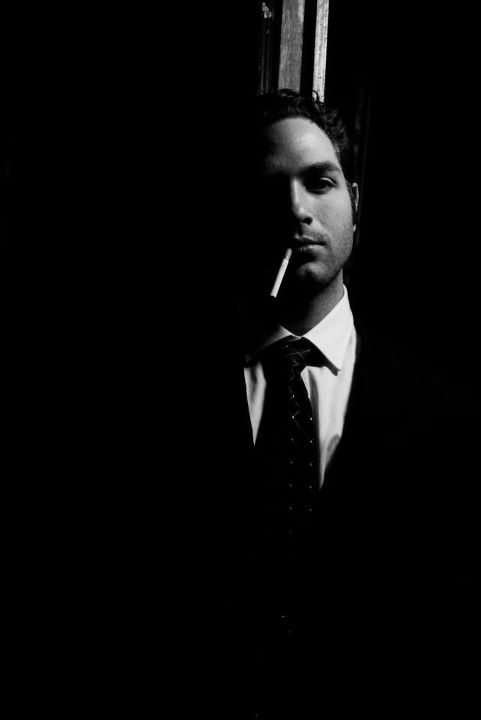
Christopher Fahmie as hard-boiled private eye Kit Marlowe
What do you get when you take film noir, throw in a heaping helping of classical mythology, and top it off with a dollop of Jacobean conceit? Words that sound like poetry, a trip to the underworld, the brink of salvation, and the depths of despair.
Read the rest of this entry »

David Harrower’s play A Slow Air aims to evoke the feeling of an old song, one that a bar full of drunks will sing in the wee hours. To do that he puts us in the moment when the song becomes meaningful: that smoky local (you know the one) late night, after the bad feelings have come up and been spit out like bile, after the accusations and recriminations, the years of disappointment and confusion, after watching your dreams modified into hopes, and even those hopes contracted to a desire to be left alone.

AL Pearsall, Becky Byers, Alisha Spielmann, Nancy Sirianni and Felicia Hudson give birth to a revolution in “Blast Radius”
Blast Radius, the second installment in Mac Rogers’s Honeycomb Trilogy, opens seventeen years after Bill Cooke, All-American Spaceman, returned from a fateful journey. A secret government cabal sent Cooke to scope Mars for terraformation, for they knew our planet was on the brink of environmental collapse and our species on the brink of extinction. But instead of gathering data for a human exodus, Cooke and company discovered an alien race who offered to save the Earth – for a price.

Scars are an aide-mémoire for Riti Sachdeva. As metaphor they fix a truth in our collective memory by fusing two apt objects. The scar etches on the body a trace of its trauma; Parts of Parts & Stitches is a raised embroidery on the fabric of history, a trace of the scar of left by the partition of India and Pakistan in 1947.

Rachel Rouge, a.k.a. Lucy Johnson
What is more fun than having sex? Talking about sex.
By far.
Thank Eros (the porn god) that we live in an age of discourse and technology, where folks from the middle classes can get their jollies amplified and fine-tuned into art.

Paul Nugent at The (Irish) Cell
Celebrate St. Patrick’s Day with two one act plays at The Cell theater.
Larry Kirwan’s “Blood” is based on the actual disappearance of James Connolly for three days in January of 1916, some months before the Easter Rising. Connolly’s three day trip “through hell” (from the program notes) should ring some church bells for the literary minded theatergoer. Like Dante, Connolly makes his trip through the Inferno of revolutionary Irish politics before ascending on Easter to participate in the (re)birth of the Irish nation.

Henry (Aidan Redmon) and Annie (Synge Maher) share a moment
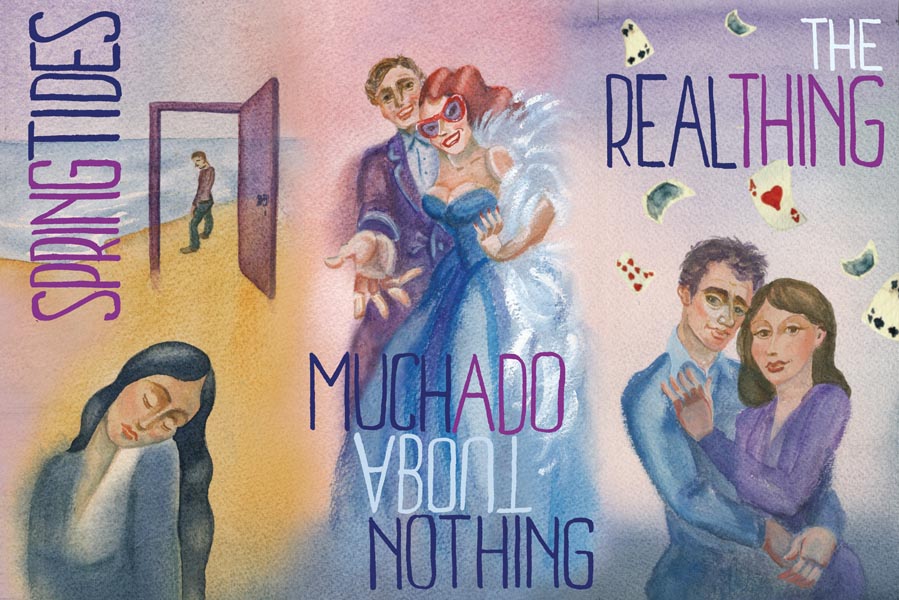
Tom Stoppard has been keeping it real since 1982 when “The Real Thing” premiered in the West End. Now you can catch the realness courtesy of the Boomerang Theatre Company at The Secret Theater in Long Island City.

In The Seeing Place Theater’s production of Chekov’s Three Sisters the birch trees, rendered abstractly on a back wall of the dilapidated ATA Sergeant Theater on 53rd Street, are uncanny sentinels, observers whose angular geometry comments on the gap between the characters’ hopes and the shifts they are forced to accept to cope with life’s capricious freaks. The company strives for a similar effect in the props and staging. The first thing you notice when you take your seat are labels in the place of theatrical property: a piece of paper with “Book” in black marker, a wooden bench labeled “Olga’s Bed” and a wooden block tagged “CLOCK.” Director Brandon Walker amplifies these Brechtian touches by requiring the stage manager to sit upstage from the actors and give cues to a tech sitting in the booth throughout the performance.
Claudio: Benedick, didst thou note the daughter of Signor Leonato?
Benedick: I noted her not, but I looked on her.
Much Ado About Nothing is a joke. That is, the title is a pun. It’s like the episode of Seinfeld where Jerry and George pitch a show to some TV execs, who ask what the show is supposed to be about. Nothing?! Who would watch that? In Shakespeare’s day matters of the heart (and the comedies that represent them) are trivial, light, ephemeral business that don’t deserve too much attention. Somebody sings, there are dancers — and yet when kids are in love they get so serious about it! Romeo and Juliet is tragic precisely because the play started out as a comedy, but rather than getting over the teen-angst, high school drama and getting on to getting it on, the characters end up killing each other. It’s like My So Called Life all of a sudden morphs into The Wire.

Mel House, Joel Nagle, and Mariko Iwasa in "Rabbit Island"
What would you do to prove your bona fides as a New Yorker? You might say, yo! Jerk face! I was born here! Uhv course Ahm a New Yowkah! You, sir, have nothing to prove. But what about those of us who moved here? Particularly those of us who moved here from The Sticks, the Great Flyover, or, worse yet, the wilds of the Great White North?
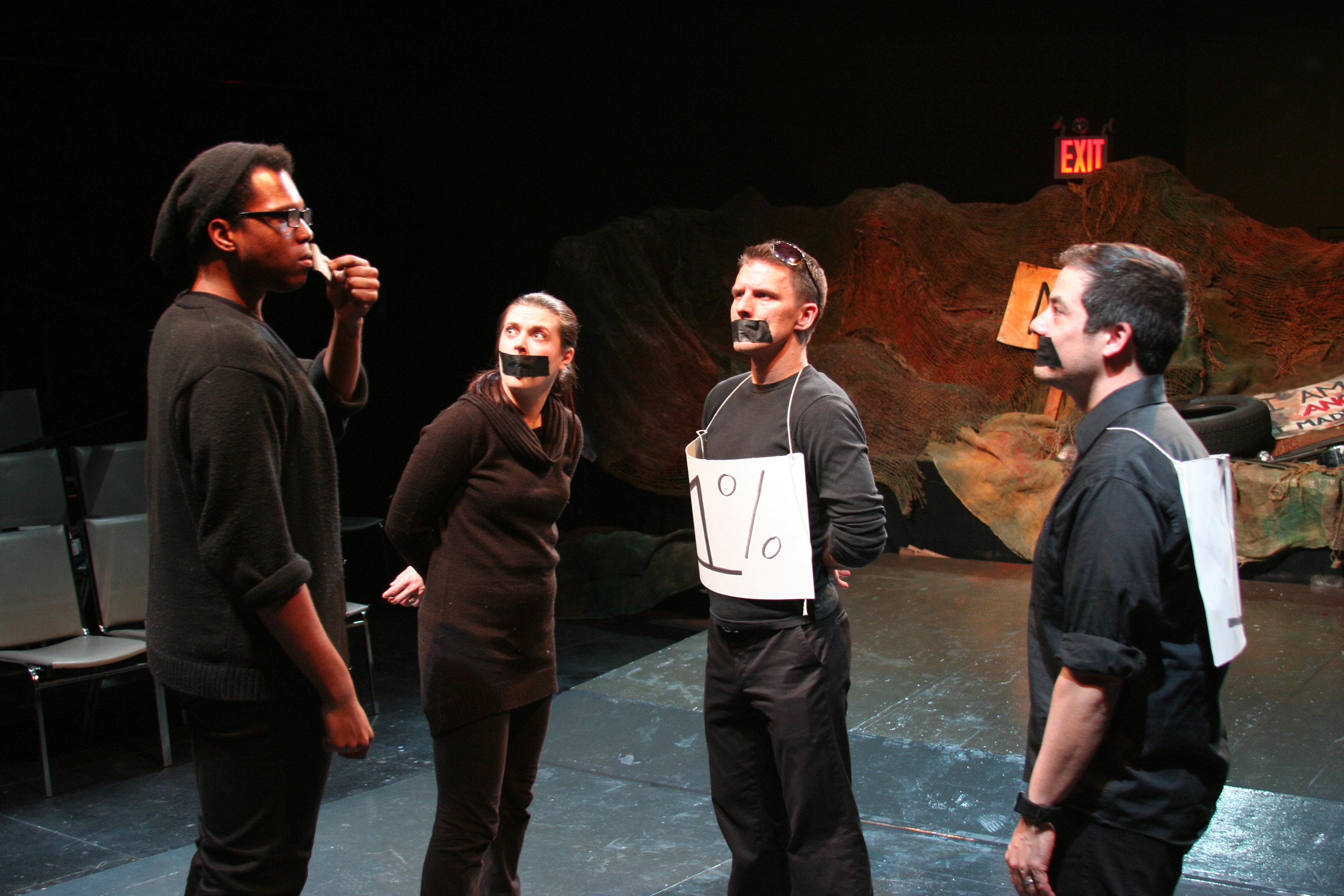
Why should politics be left to politicians? If they had their way we’d all be waving flags and buying crap on credit, while the corporate-government revolving door does enough RPMs to power a generator that could light up Manhattan. On the other hand, if the unwashed masses had their way we’d all be burning flags and sharing watery vegan gruel in the mess halls of our workers’ collective. I propose that politics should be handled exclusively by playwrights. If you check out Created Equal at The Theater at the 14th Street Y anytime from now until February 12th, you’ll know why. This collection of six short plays will entertain you, outrage you, inspire you, and give you debating points for weeks to come.
Created Equal is the second production this season for The Red Fern Theatre Company, whose mission is “to provoke social awareness and change through its theatrical productions and outreach.” The six plays that comprise the show are by exciting, young New York playwrights J. Holtham, Kristen and Luanne Rosenfeld, Anna Moench, Rob Askins, Jen Silverman, and Joshua Conkel, who took the assignment to write on inequality in America seriously.
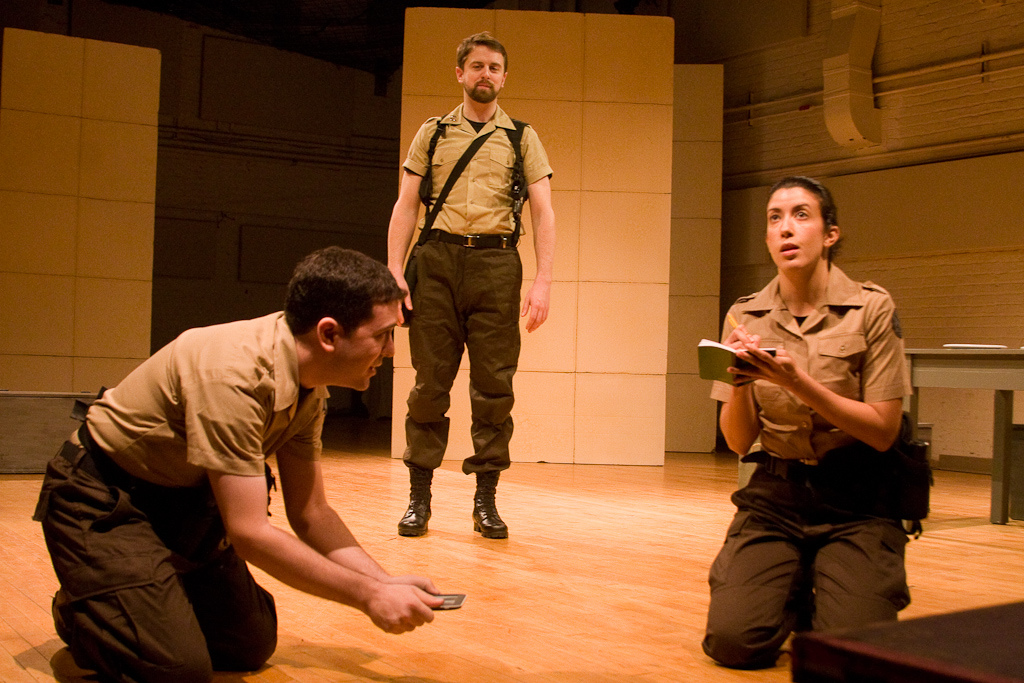
Isaiah Tanenbaum, Matt Archambault, and Sol Marina Crespo in "Menders"
“Instant ardentes Tyrii: pars ducere muros / molirique arcem et manibus subsolvere saxa…” Aeneid I, 423-24
The toiling Tyrians on each other call
To ply their labor: some extend the wall;
Some build the citadel; the brawny throng
Or dig, or push unwieldly stones along. (Dryden)
In pre-modern times cities of any respectable size had walls. If you have ever been to York, Barcelona, Carcassonne, Istanbul, Rome, or Jerusalem, you have seen their skeletal remains, like the spines of long-dead dinosaurs bleaching in millennial sunlight. These days there isn’t much point in putting a wall around your city, what with transcontinental missiles, stealth bombers, drones and such. That doesn’t mean walls have gone out of style though. Bin Laden thought walls would protect him. Ditto for KimDotcom. Rich people from Johannesburg, South Africa to Briar Ridge, Indiana build neighborhoods with walls and walled estates within those neighborhoods. One is tempted to say with Frost, “Before I built a wall I’d ask to know / What I was walling in or walling out.” Is the disparity between rich and poor so great that it has to be protected and reinforced by a wall?
This certainly seems to be the case in Erin Browne’s new play Menders. The play is set sometime in the future when the United States is no more, but a few communities have survived to build protective walls. These walls serve the same purpose as pre-modern walls: they keep out the barbarians. Inside the walls two young people, Aimes and Corey, just graduated from the academy, are field training with Drew, a veteran who is about to retire. The Menders are the professional fence tending force that monitors and maintains the stone border between us and them. In the hierarchy of Browne’s futuristic American police state, they rank second only to Investigators and well above civilians. Corey is an idealistic, patriotic young woman who sees the Menders as a social ladder she will take pride in climbing. Aimes is her cousin. He is nervous and excitable. For him the Menders are a uniform he must put on because he fears what people might think if he doesn’t.

“Salesman, impresario, merchandiser of illusions, rainmaker, image-publisher, gun for hire, programmer of protocol, spontaneous demonstration organizer, the advance man is one part Willy Loman, one part Sol Hurok, one part Al Capone, and one part Emily Post.” – V. Navasky
“Cain slew Abel, and Romulus slew Remus; violence was the beginning and, by the same token, no beginning could be made without using violence, without violating.” –Hannah Arendt
2012 is already living up to its reputation. End of the world, here we come!
In the spirit of New Beginnings, Revelations, and End-Of-The-World Excitement, Mac Rogers is premiering the first play of his sci-fi “Honeycomb Trilogy,” Advance Man, at The Secret Theater in Long Island City. I’m telling you, it doesn’t get more occult, conspiratorial, thrilling, bizarre, or (frankly) gnostic than this.
“You may call me a dreamer, but I’m not the only one.” — J. Lennon.
When Albert Goldman’s biography The Lives of John Lennon came out in 1988 it was roundly attacked. Paul McCartney called it “a piece of trash,” and Rolling Stone said it was “riddled with factual inaccuracies.” Goldman had savaged a pop music saint, and no one would give credence to Lennon’s feet of clay — much less Goldman’s insistence that Lennon was a hollow idol, who in real life was cruel, selfish, and manipulative. The trivial truth was that Lennon was human, and as such, full of human failures, limitations, and fears. But the way he inspired people to dream about love and forgiveness made him seem above mere humanity in the eyes of his fans.
The same could be said for those paragons of working class heroism, the heroes of comic books. As mythological creatures, demi-gods of popular culture that first sprang to life during the Great Depression, they fight bad guys with an unambiguous “pow!” “zap!” and “ka-blammo!” In the 80s it became fashionable to make the heroes more human (e.g. “Superman III,” “Legends of the Dark Night”), and audiences came to understand that the flaws of their heroes made them paradoxically more heroic. The pathos of Superman or Batman is a product of their limitations, not their powers. But their essential heroism is still pure: they know who the bad guys are and how to defeat them in thirty-six pages or less.
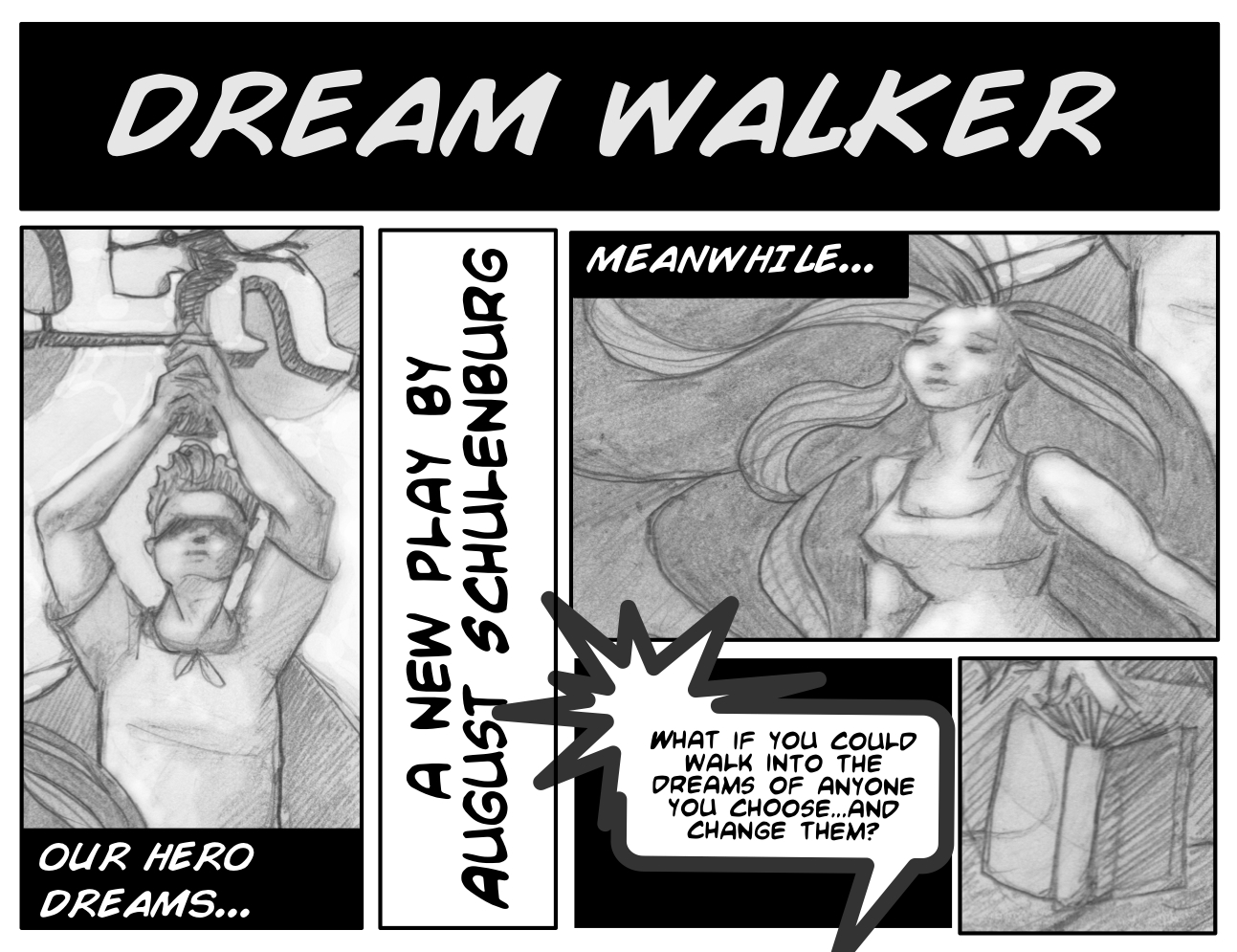
August Schulenburg’s new play Dream Walker presents us with a hybrid working class hero. Richie, played by Collin Smith, is part Lucy in the Sky, poetic dreamer and part Annikken Starkiller, natural born ass kicker. He is a social misfit, hopeless romantic, and allergic to money. His older brother Gary, played by Matthew Archambault, works in the “real world” to support Richie with food, raiment, and shelter while Richie crafts a Tolkien-esque fantasy novel that may never see the light of day. But Richie has two special powers: as a writer (unpublished when the play opens) he has the very human power of weaving beautiful stories; as a comic book hero he is able to enter people’s literal dreams and influence them.

Haley and Morton and The Cube
Julia Jarcho’s new play Dreamless Land is, in fact, all a dream. The action starts when a young woman, Haley, enters the performance space clutching a teddy bear to her chest. Around the stage sit three people: an older man, an older woman, and a young man. She nods to them in turn, and they beep like off-duty automatons from The Stepford Wives or Blade Runner. The young man seems to resist her, so she nods at him forcefully once more. He beeps again, takes a propeller beany out of the wooden box on which he sits, and puts it on his head. Haley takes a seat upstage and watches as the three perform a family drama whose theme is fracture, dislocation, and fear. Father appears to be an alcoholic abuser. Mother is emotionally distant. And Morton, their son, escapes into technology, nebulously defined as a glowing, translucent cube inside a larger transparent plexiglass cube that sits in the center of the stage.

Bad zombie kitty!
Though Halloween is gone, the terror lingers on. Brew of the Dead II: Oktoberflesh is a feature length homage to “horror” (notice the scare quotes) that will literally make your skin crawl.

Pumpkin Pie sounds like Halloween, and if you’re in the mood for a good, fun night of creepy and cheeky, check out “The Pumpkin Pie Show: Lovey Dovey” at Under St. Mark’s Theater from now until October 29th.

Larry checks out what Alice has on offer in "Closer"
Love stinks.
You don’t need the J. Geils Band to tell you that. But why does it seem that the Internet makes it so much more fun to hurt the ones you love and love the ones that hurt you? Maybe it’s the anonymous proximity, maybe it’s the dazzling newness of social tech, or maybe it’s the mind-blowing ubiquity of porn that killed romance for Dan, Alice, Anna, and Larry in Patrick Marber’s 1997 play Closer.
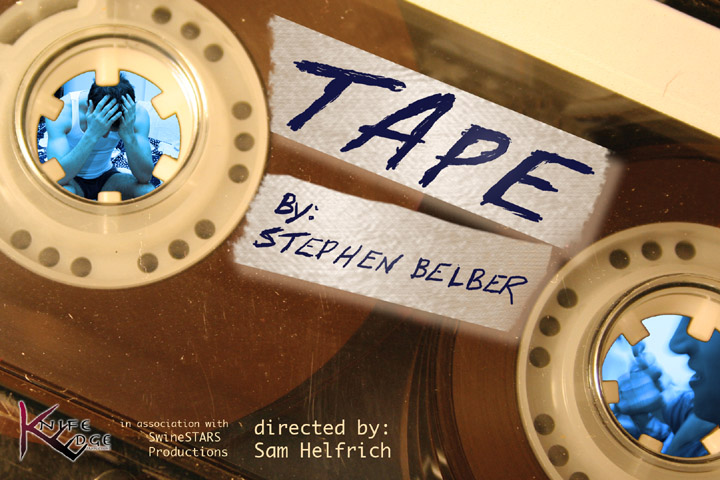
Jon Saltzman is a young filmmaker embarking on a promising career. His high school best friend Vince is a burn-out, low level drug dealer. They meet in a hotel room in Lansing, Michigan to catch up and, in Vince’s case, get even. To do so, Vince gets Jon to admit on tape that he date raped Amy, Vince’s high school girlfriend and first love. When Amy, now the assistant district attorney in Lansing, shows up, each one of them has to face the past and choose between forgiveness and justice.

Melody Bates as Dina
The past is a strange and distant country, and we are refugees with no right of return. J. Stephen Brantley’s new play 83 Down playing at Under St. Marks is a postcard from that country. On one side is a montage of evocative images – Duran Duran posters, car telephones, TV top cable boxes, Ronald Reagan’s avuncular smile – and on the other side is a cryptic prophecy that reads: pleasure is punishment; freedom is bondage.

The revolution will be dramatized
Next door to Barberry on Metropolitan Avenue in Williamsburg is a red door, the kind that usually hides a garage or machine shop populated by illegals working eighteen hour shifts. If once it locked up the hopes of the unfortunate, now it is home to The Assembly’s production of “Home/Sick,” a play the company wrote collectively about the Weather Underground, the Marxist revolutionary group who declared war against the United States in 1970s and early 80s.
The former garage (or sweatshop, or whatever) opened its mysterious door soon thereafter. A nice fellow wearing mirrored sunglasses, a black suit, and an earpiece (obviously one of Hoover’s G-Men) offered me some refreshingly cold and free water. He told me to take a button sporting the slogan “Your Brain Is A Bomb.” I took my seat, wiped the perspiration from my brow, and settled back in my chair, ready to be entertained.

Melissa Johnson as Cassandra and Amy Lee Pearsall as Hecuba in "The Trojan Women"
The enduring appeal of classic plays is sometimes hard to understand. In Shakespeare’s case, the play can be literally hard to understand. Even well-educated viewers can miss out substantially on the Bard’s subtleties of language, not to mention the differences in sensibility between twenty-first century Moderns and sixteenth century Elizabethans. And he wrote in English! With Greek drama – particularly tragedy – the difference between how they saw the world and how we see the world is particularly wide. Though the Athenian government of the 5th century was democratic, only ten percent of the total population was enfranchised, and every family of means owned slaves. Though some ancient Greeks invented rationalism and science, their most devout religious rituals looked like a mix of Burning Man and Bonnaroo. And their view of fate was fare more bleak than our belief in Divine Providence, which, in our secular age, we call American Exceptionalism.

Sarah Quinn’s performs “Other People’s Problems” at Stage Left Studio in Chelsea this Friday and Saturday. It is an entertaining hour of satire on Anglo culture’s obsession with perfection and the soul killing emptiness of the industries that have developed to exploit it.
The show is three short plays punctuated by clever video productions. The first play imagines that we are at a self-help seminar; the second is a web cam chat with a teenage, Australian Ann Landers; and the third is a British woman listening to a self-help tape, hoping it will boost her confidence enough to speak to that special guy.
The skits get better as the show goes on (though that may be because I saw the show opening night). The first one is a bit dated. It is a send-up of the self-help seminars that proliferated in the 1990s that P. T. Anderson satirized in “Magnolia.” Long story short, the person offering advice needs to follow it herself. The second segment is brilliant however – a subtle autopsy of the nexus between technology and our all-too-human need for love and acceptance. Of course, this is the central theme of the entire show: when we seek out “self” help we are, in fact, trying to reach out to another, perhaps our ideal self, but more likely the friend or lover who is going to recognize and complete us.
In all three shorts Ms. Quinn shows off her finely tuned acting chops. She displays fine comedic sensibilities, and there is never a dull second in the hour.
Other People’s Problems
214 W 30th Street, 6th floor
June 23, 24@ 7:30pm
$20

Christina Shipp and Stephen Conrad Moore as A.J. and Ajax in Iraq
Ellen McLaughlin, author of Ajax in Iraq, turned to the ancient Greeks to make sense out of our soldiers’ experience in Iraq because the Greeks were the first to make sense of the fear, rage, and terror that constitute war by creating a theater for veterans and by veterans. Aeschylus fought in both the battles of Marathon and Salamis (c. 480 BCE). Sophocles was 16 when the Greeks triumphed at Salamis and served as a citizen general in the Athenian army during the Peloponnesian War. These were men who knew the terrors of war first hand, and it is their authority McLaughlin draws on to untangle the Gordian knot of meanings that are present for us, Americans, about our ten-year wars in Iraq and Afghanistan.

Nicole Beerman, Joe Varca, and Megan Hill in "Cut"
Welcome to the machine.
Cut by Crystal Skillman is a theatrical piece about TV, a play about the seriousness of the entertainment industry, a post-modern meditation on Post-modernism. If that sounds like a lot to chew on, it is. Cut is a theatrical essay on the socially constructed nature of “reality,” the brass ring to which all serious artists aspire. And Ms. Skillman has fostered a reputation as a downtown playwright who isn’t afraid to take on The Big Questions. Take, for instance, her play The Vigil or the Guided Cradle, a play about the universality and timelessness of torture in the human experience. The “cut” of the play’s title is its guiding metaphor. A “cut” is what an editor does to film to create a story; what your boss does to your job to save his own skin; and – the cruelest cut of all – what the critic does to put you in your place.

Joanne Wilson as Jane in "Dirty Little Machine"
Miranda Huba’s Dirty Little Machine should be subtitled “Jane’s Ambivalence and Dick’s Dilemma.” Jane, the protagonist, is ambivalent about our “dirty little machine,” which is Huba’s elastic metaphor for the mechanization, specialization, technologization, and anatomization of sexuality in this (post)modern era. That is, porn. And the appropriately named Dick is her two-dimensional foil, he who she calls “The Weasel” because he has collapsed the Madonna / whore dichotomy into one misogynistic, incestuous, feminine catch-all category. I don’t think I’m giving anything away by saying sex in Dirty Little Machine is what bored people do to pass the time between permanent adolescence and senescent despair.
 culturalcapitol.com